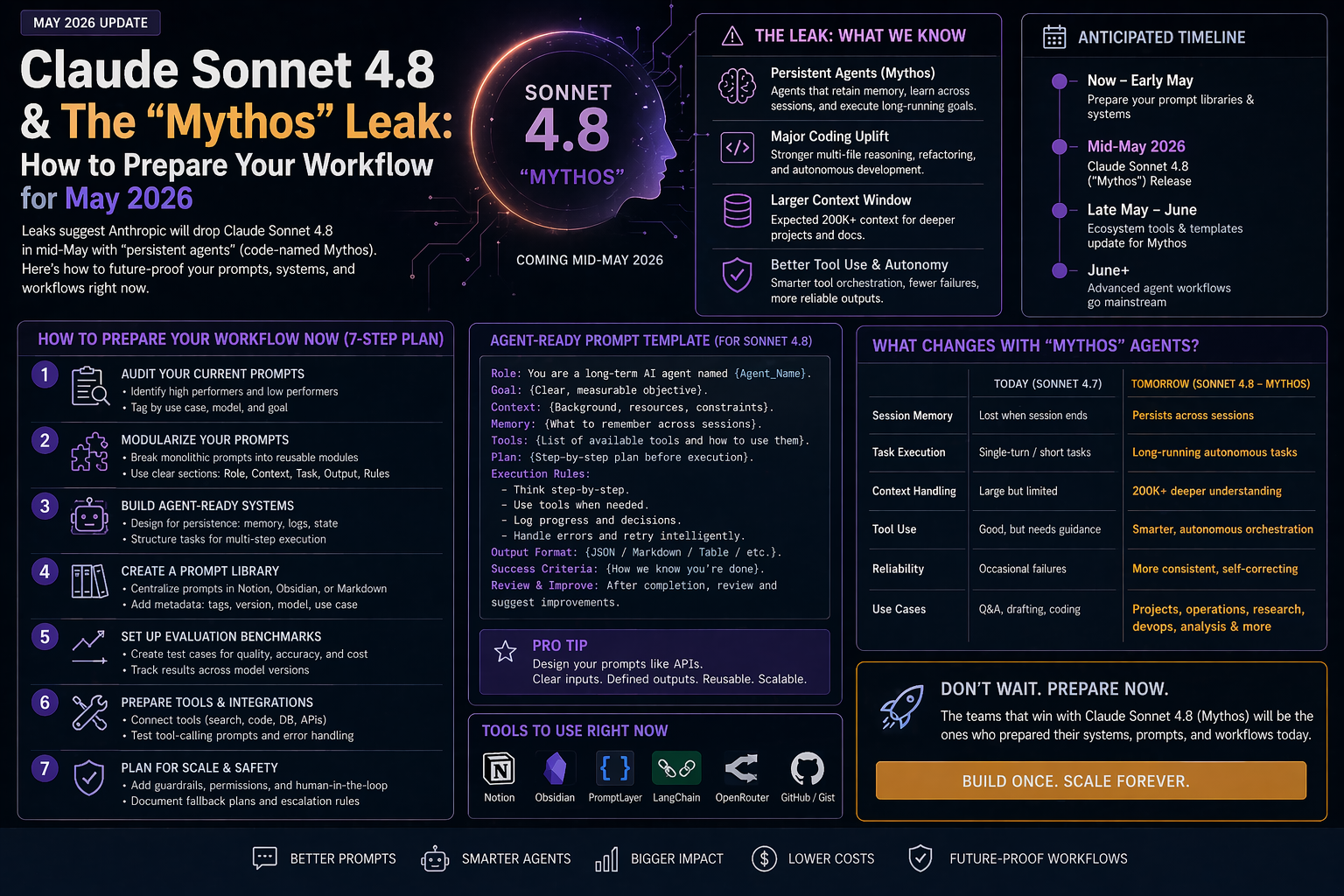
A New Kind of AI Is Dropping This Month. Here Is How to Get Ready Before Everyone Else.
The AI community is buzzing with a specific kind of anticipation right now. Not the usual hype cycle that accompanies every minor update. This is different. Leaks from credible sources, documented in *Claude Sonnet 4.8: Release Date & Persistent Agent Leaks*, point to Anthropic launching something genuinely new in mid-May 2026. The model is Claude Sonnet 4.8. The codename that keeps appearing is "Mythos."
The reason this leak has operators paying attention is not just better benchmark scores. The leaks describe something called persistent agents, autonomous AI helpers that do not forget your context between sessions and can take action on your behalf over hours or even days. If the leaks are accurate, the way we work with AI is about to change again.
Most people will wait until the launch day, scramble to understand what changed, and lose weeks figuring out how to adapt their workflows. You do not have to be one of them. This guide explains exactly what the Mythos leak suggests and how to prepare your prompt library, your workflows, and your business right now, before the update drops.
What the Mythos Leak Actually Says
Separating verified signals from speculation is important. Here is what credible leakers and early testers have converged on regarding Claude Sonnet 4.8 and its Mythos feature set.
Persistent Memory Across Sessions. This is the headline change. Currently, even the best models treat each conversation as largely independent. You start a new chat, and you reintroduce context. Mythos reportedly allows the model to maintain a persistent identity and memory across days and multiple conversations. It remembers who you are, what you are working on, and your preferences without needing to be retold.
Agentic Autonomy. The leaks suggest Mythos agents can be assigned long-running tasks. You give an objective, and the agent works on it in the background. This is not the same as leaving a chat window open. The agent reportedly operates asynchronously, updating you when it has completed the task or when it needs a decision. Think of it as moving from giving the AI a single instruction to giving it a project brief.
Tool and API Access by Default. Mythos agents are rumored to connect natively to external tools like calendars, email, code repositories, and web browsers. This means an agent could theoretically research a topic, draft a report, schedule a meeting about it, and send you a summary, all from one initial prompt.
If this sounds like the agentic workflows already being built by AI Agent Architects, that is no coincidence. Anthropic appears to be productizing what power users have been manually assembling with external tools. The difference is Mythos makes it native, integrated, and accessible to anyone.
Why Preparation Now Is a Competitive Advantage
When a major model shift happens, there is always a window of chaos. Most users spend the first two weeks experimenting aimlessly. Smart operators who prepared their assets in advance capture disproportionate value during that window.
This is the FOMO that matters. Not the social media panic of being left behind, but the practical advantage of being operational on day one while competitors are still reading changelogs. The same principle applied when AI tools first opened up serious income opportunities for Nigerians. First movers captured the easiest gains.
Your preparation advantage is that you already know the direction of the update. Persistent agents with memory and autonomy. You can structure everything so that when Claude Sonnet 4.8 drops, you switch from your current workflow to the upgraded one in hours, not weeks.
How to Prepare Your Prompt Library Now
Your prompt library is the collection of instructions, templates, and workflows you use regularly. Right now, those prompts are probably written for a single-session, single-task model. Mythos requires a different structure. Here is how to upgrade your library before launch day.
#
Audit and Categorize Your Current Prompts
Go through every prompt you use regularly. Sort them into three categories:Tag every prompt in the third category. These are your highest-priority assets.
#
Rewrite Multi-Day Prompts with Persistent Context in Mind
For every prompt tagged as a multi-day workflow, rewrite it now with a persistent agent assumption. Instead of starting with "Here is the context for today," write it as an ongoing brief.Here is the practical transformation using a real scenario. Imagine you manage content for a monetized Telegram channel.
Current prompt style:
"I run a Telegram channel about P2P crypto trading in Nigeria. Today I need 5 post ideas about avoiding common trading mistakes."
Mythos-ready prompt style:
"You are my content manager for a Telegram channel on P2P crypto trading in Nigeria. Remember that our audience is mostly beginners, our top-performing posts are practical safety guides, and we post twice daily at 9 AM and 5 PM WAT. Going forward, every weekday you will suggest 5 post ideas aligned with our content pillars. Flag any ideas that overlap with posts we have already published this month."
The second prompt sets a persistent mandate. Once Mythos is live, you give this instruction once, and the agent maintains it across all future interactions. Write all your multi-day prompts in this style now, and you simply paste them into a new Mythos session on launch day.
#
Build a "Brand Voice and Rules" Master Document
The most powerful asset for a persistent agent is a detailed standing instruction document. Draft one now. It should contain:This document becomes the "bible" you feed to your Mythos agent on day one. It removes the friction of re-explaining fundamentals and lets the agent operate with full context from the first instruction.
How to Prepare Your Business Workflows
Beyond prompts, think about which business processes you will hand off to a persistent agent immediately.
Customer Inquiry Handling. Draft a comprehensive FAQ and response playbook. A Mythos agent connected to your email or social media DMs could handle tier-one customer inquiries for your Instagram selling business by referencing this playbook.
Competitor Monitoring. Prepare a brief that instructs the agent to monitor specific competitor accounts weekly, summarize their content strategy changes, and flag anything you should respond to.
Content Distribution. Map out your full distribution workflow. A persistent agent should be able to take a published blog post and draft adapted versions for Telegram, Twitter, Instagram Stories, and your email newsletter without being retold the format each time.
Document each of these workflows now. The more structured the instruction, the more effectively a Mythos agent executes it.
One Cautionary Note
Persistent agents are powerful, but autonomy means risk. A misconfigured agent posting directly to your social media or emailing your customers without human review is a liability. The leaks suggest Anthropic is building in safety guardrails, but the operator's principle remains: trust but verify. Set up your workflows so the agent drafts and you or your virtual employee approve before anything goes live.
Your preparation window is the next two weeks. Audit your prompts, rewrite your multi-day workflows, build your brand voice master document, and map out the business processes you want to hand off. When Claude Sonnet 4.8 with Mythos drops, you will not be reading announcement threads. You will be working, already optimized, already ahead.