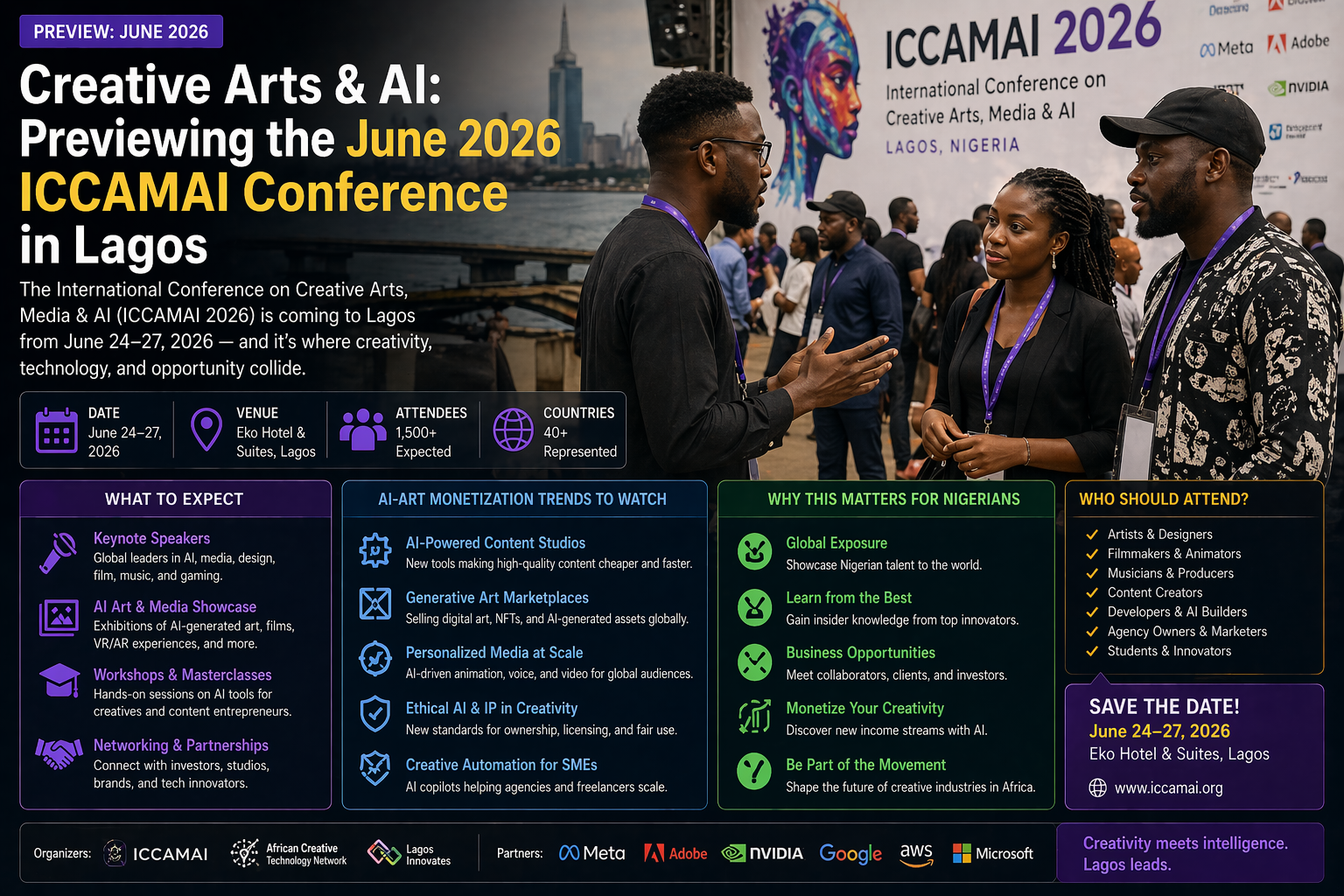
The Biggest AI and Creative Arts Event Is Landing in Lagos This June. Here Is What to Expect.
The global conversation about AI and creativity has spent too long happening elsewhere. Conferences in San Francisco. Summits in London. Workshops in Berlin. Nigerian creators, who produce between 10,000 and 15,000 pieces of original content daily across more than 60 digital platforms, have largely been spectators to a conversation they should be leading [citation:1].
That changes in June 2026. The International Conference on AI, Media and Creative Arts, ICCAMAI, is landing in Lagos. This is not a virtual event or a satellite meetup. It is a full-scale international conference bringing together AI researchers, digital artists, filmmakers, music producers, policy makers, and platform executives on Nigerian soil.
For anyone building a career at the intersection of creativity and technology, this is the most important event on the Nigerian calendar this year. Here is everything you need to know about the conference, the trends it will spotlight, and how to position yourself before the doors open.
What the ICCAMAI Conference Actually Is
The International AI and Creative Arts Conference 2026 is a major gathering focused entirely on how artificial intelligence is reshaping creative industries. Unlike general tech conferences that treat AI as one panel among many, ICCAMAI places AI and creativity at the center of every discussion.
Based on the conference agenda and participant list, the event covers a broad sweep of disciplines. Sessions are planned on AI in film production, generative music and copyright law, AI-assisted animation, virtual and augmented reality storytelling, digital fashion design, and the ethics of AI-generated content. The speaker lineup includes international AI ethics researchers, Nigerian filmmakers already integrating AI into their production pipelines, legal experts specializing in intellectual property, and platform representatives from companies building creator-focused AI tools.
The timing is deliberate. Nigeria's AI market is currently valued at approximately $434.4 million, with projections pointing toward multi-billion-dollar growth by the decade's end [citation:2]. The creative sector is a major driver of that valuation. Bringing a conference of this scale to Lagos signals that the global AI community recognizes Nigeria not just as a consumer of AI tools, but as a producer of AI-driven creative work.
Why This Conference Matters for Nigerian Creators
The practical value of ICCAMAI goes far beyond sitting in an air-conditioned hall and collecting business cards. Several converging trends make this specific conference at this specific moment particularly valuable.
The monetization conversation is shifting. The Federal Government has explicitly stated through the National Council for Arts and Culture that Nigerian creators need to move beyond engagement metrics and toward genuine monetization [citation:1]. The NCAC Director-General recently emphasized that the goal is no longer just views and likes. It is about retaining intellectual property value domestically and enabling creators to derive sustainable income from their work. ICCAMAI panels are expected to address exactly this: how AI tools can become revenue engines, not just content accelerators.
Local AI infrastructure is being built. Across Lagos, AI-powered creative studios are emerging. A pioneering solar-powered AI animation studio in Ijora Badia has already trained 10,000 children in AI-assisted storytelling during its pilot phase and is now scaling toward industrial production [citation:4]. Initiatives like these demonstrate that AI creativity in Nigeria is not theoretical. It is operational, and it is scaling. The conference provides direct access to the people building this infrastructure.
Legal frameworks are catching up. The copyright questions that have haunted AI-generated content, who owns an AI-assisted song, whether AI models trained on Nigerian music owe royalties to original artists, are being actively litigated and legislated [citation:6]. ICCAMAI includes legal panels addressing these questions directly. For creators who want to monetize AI-assisted work without getting caught in ownership disputes, this is essential education.
The Networking Opportunity Most People Will Miss
The most valuable part of any conference is not what happens on stage. It is the conversations in the hallways, at the lunch tables, and during the evening side events. ICCAMAI will concentrate a specific type of person in one location: people who have already figured out how to make money from AI-assisted creative work.
These are the filmmakers using AI to cut post-production timelines from weeks to days. The advertising creatives running AI-generated campaigns that cost a fraction of traditional production. The musicians navigating the new world of AI vocal synthesis and licensing. The visual artists building entire brand identities using generative tools.
Most attendees will attend the panels and go home. A much smaller number will actively network, exchange contacts, and follow up afterward. Those are the people who will leave with collaborators, clients, and opportunities. This is the same dynamic that separates successful freelancers on Fiverr and Upwork from those who struggle. The platform provides access, but the individual must convert that access into relationships.
AI-Art Monetization Trends That Will Dominate the Discussions
Based on the conference agenda and broader industry signals, several specific monetization trends are expected to feature prominently.
AI-assisted brand content at scale. Nigerian creators are increasingly using AI tools to produce commercial content faster and cheaper than traditional methods. Photographers who once charged premium rates for basic product shots are seeing competition from e-commerce sellers who generate professional-grade model images using AI [citation:9]. The conference will likely showcase case studies of brands that have shifted their content production to AI-assisted workflows and the revenue impact of that shift.
Virtual influencers and AI-generated media properties. Creators are building entirely AI-generated characters that accumulate followers, secure brand deals, and generate revenue without a human appearing on camera. This is not a future trend. It is happening now, and ICCAMAI panels are expected to feature creators who have already built sustainable income streams from virtual media properties.
Cross-platform AI content adaptation. Meta's Creator Support team for Sub-Saharan Africa has highlighted translation and dubbing tools that allow Nigerian creators to reach global audiences by automatically adapting their content into multiple languages [citation:7]. A video created in English can be dubbed into French, Swahili, and Portuguese with AI retaining the original speaker's vocal characteristics. This multiplies audience reach without multiplying production costs. The conference will likely include demonstrations of these tools and strategies for monetizing international audiences.
AI music and the copyright frontier. The legal panel at ICCAMAI is expected to be one of the most heavily attended sessions. The recent viral success of AI-generated music tracks, some charting on Billboard while raising unresolved ownership questions, has made copyright law urgent for any creator using AI in music production [citation:6]. Understanding the legal landscape is now a prerequisite for commercial AI music work.
How to Position Yourself Before the Conference
Showing up unprepared to a conference of this caliber is a wasted opportunity. The people who extract maximum value from ICCAMAI will do specific preparation in the weeks before the event.
Build a portfolio of AI-assisted work now. You cannot network effectively if you have nothing to show. If you are a writer, create samples using AI writing and editing tools. If you are a visual artist, build a small collection of AI-assisted pieces. If you are a developer, document a project that demonstrates your skills. Your portfolio is your conversation starter.
Study the speaker list and identify your targets. The conference will publish its full speaker and panelist lineup before the event. Identify five specific people you want to connect with. Research their work. Prepare thoughtful questions. A generic "I love what you do" gets forgotten. A specific observation about their recent project gets remembered.
Prepare your payment and subscription infrastructure. Many of the AI tools discussed at the conference require dollar-denominated subscriptions. If you leave ICCAMAI inspired but cannot actually access the tools because of payment friction, the inspiration is wasted. Set up a functional virtual dollar card before the conference so you can act on what you learn immediately. This is the same infrastructure you need for any dollar-paying remote work.
Understand the legal basics before the legal panels. Read up on the Nigerian Copyright Act 2022 and its provisions regarding AI-generated works [citation:6]. You do not need to become a lawyer. But walking into a copyright discussion with zero context means you will miss the nuances that could protect or jeopardize your future work.
The Bigger Picture: Why Lagos?
The decision to host ICCAMAI in Lagos rather than in Europe or North America is not charity. It is a market calculation. Nigeria's creative output is massive and growing. The country's creator economy is among the most active globally, with content reaching an aggregate audience of over three billion people annually [citation:1]. AI companies and platforms recognize that their next wave of growth depends on empowering creators in markets like Nigeria.
The conference is an acknowledgment that Nigerian creators are not peripheral to the AI and creativity conversation. They are central to it. The question is whether individual creators will recognize the opportunity and position themselves to capture it.
Mark the dates. Prepare your portfolio. Set up your tools. The biggest AI and creative arts event in Nigeria this year is coming. The difference between attending and benefiting will come down to preparation.