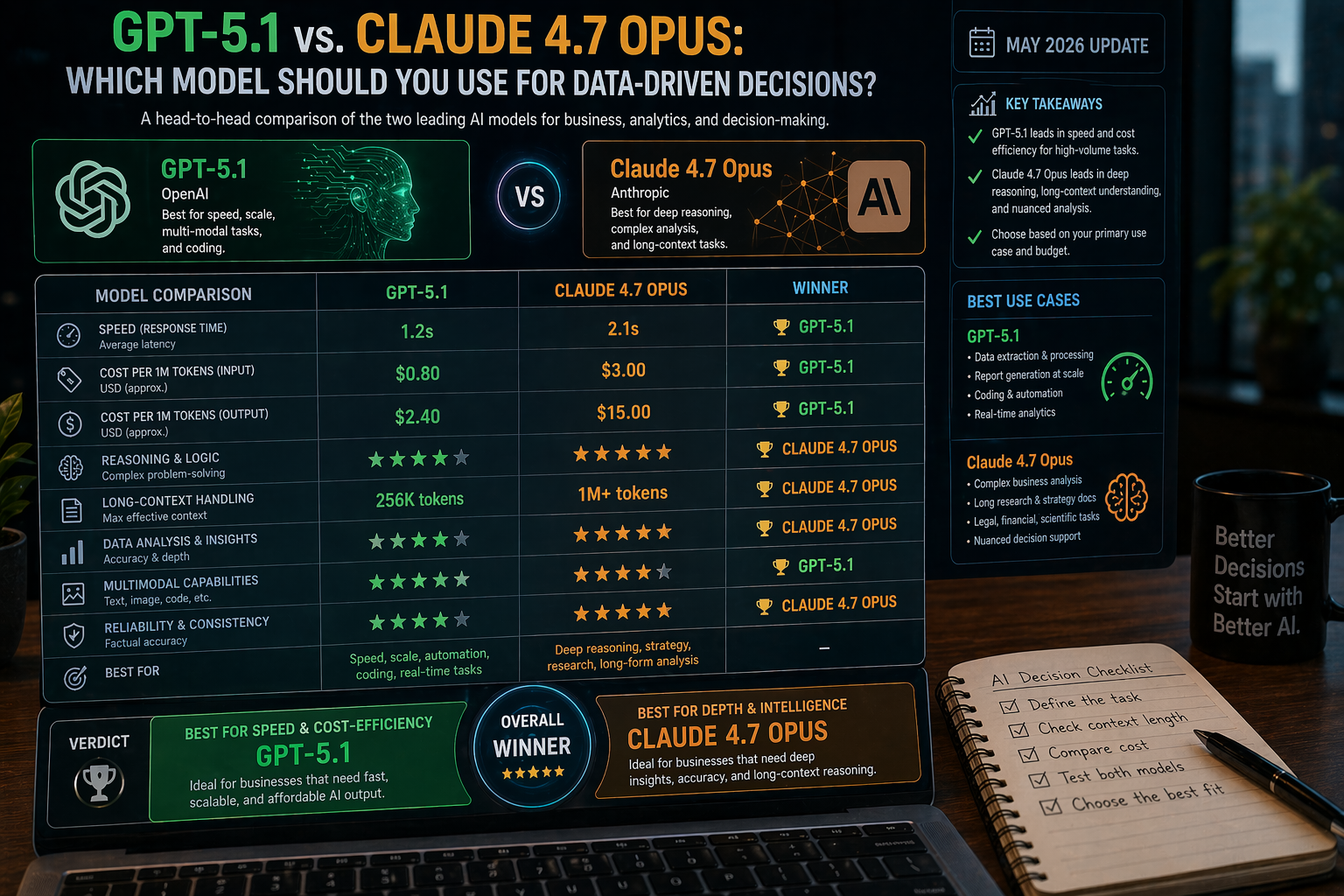
Two AI Giants. One Choice for Your Business. Let's Settle This.
The AI model you choose as your daily driver directly impacts the quality of decisions you make. If you are running a digital business from Nigeria, whether it is analyzing market trends, writing high-converting sales copy, or interpreting complex data, the difference between a good model and the wrong model shows up in your revenue.
May 2026 brings a direct collision between two updated heavyweights: OpenAI's GPT-5.1 and Anthropic's Claude 4.7 Opus. Both are top-tier. Both have vocal champions. But they are not the same tool, and picking the wrong one for a specific job wastes time and produces subpar results.
As *What's Next in AI: 7 Trends to Watch in 2026* outlines, the frontier of model development has shifted from raw size to specialized intelligence. This comparison focuses purely on which model wins for data-driven business decisions so you can stop guessing and use the right tool for the right task.
The Core Difference in One Paragraph
Before we break into specifics, understand the philosophical split between these two models.
GPT-5.1 is built for speed, breadth, and multimodal reach. It is the generalist that processes text, images, audio, and code inside a single workflow without breaking stride. It generates ideas fast.
Claude 4.7 Opus is built for depth. Its architecture prioritizes long-context reasoning, careful analysis, and what Anthropic calls "constitutional" decision-making. It is the specialist that reads a 200-page document and finds the one paragraph that changes your strategy.
Your choice depends on whether your decision requires breadth or depth.
The Winner Table: Head-to-Head at a Glance
Here is the direct comparison across the metrics that matter for business decisions.
| Capability | GPT-5.1 | Claude 4.7 Opus | Winner |
|---|---|---|---|
| Speed (Tokens per Second) | ~180 t/s output | ~95 t/s output | GPT-5.1 |
| Cost per 1M Input Tokens | $2.50 | $8.00 | GPT-5.1 |
| Cost per 1M Output Tokens | $10.00 | $24.00 | GPT-5.1 |
| Context Window | 256K tokens | 1M+ tokens (near-infinite memory) | Claude 4.7 Opus |
| Logical Reasoning (Complex) | Strong | Exceptional | Claude 4.7 Opus |
| Data Analysis (Spreadsheets, CSVs) | Strong | Exceptional | Claude 4.7 Opus |
| Multimodal (Vision, Audio) | Excellent (native audio) | Good (vision only) | GPT-5.1 |
| Code Generation & Debugging | Excellent | Very Good | GPT-5.1 |
| Deep Document Review | Good | Exceptional | Claude 4.7 Opus |
| Nuance & Ethical Judgment | Good | Exceptional | Claude 4.7 Opus |
This table tells a clear story. GPT-5.1 wins on cost and speed. Claude 4.7 Opus wins on depth and reasoning. The rest of this guide explains when each victory actually matters for your business.
When to Use GPT-5.1: Speed and Multimodal Flexibility
GPT-5.1 is your model when the decision requires velocity and synthesizing different types of data quickly. It shines in these specific business scenarios.
#
Real-Time Content Production
If you run a content-driven Instagram or Telegram business where you need to react to trending news, draft posts, and generate image captions in minutes, GPT-5.1's speed keeps you ahead of competitors. The 180 tokens per second output means a full blog draft arrives before Claude finishes its first paragraph.#
Multimodal Workflows
GPT-5.1 handles text, image analysis, and audio natively. If you are reviewing a competitor's TikTok video, extracting the audio transcript, analyzing the visuals, and generating a response script, GPT-5.1 does all of this inside a single interface without needing external tools. For social media sellers on Instagram, this unified workflow saves real hours per week.#
Cost-Sensitive Operations
At $2.50 per million input tokens versus Claude's $8.00, GPT-5.1 is significantly cheaper for high-volume work. If your business processes thousands of customer inquiries or generates large batches of product descriptions daily, the cost difference compounds into meaningful savings. This is the same principle as optimizing your P2P crypto trading fees. Small percentage differences matter at scale.When to Use Claude 4.7 Opus: Deep Reasoning and Massive Context
Claude 4.7 Opus earns its premium pricing when the decision is complex, high-stakes, or requires holding an enormous amount of information in active memory.
#
Complex Data Analysis
Upload a year's worth of sales data in a CSV or an unstructured PDF contract. Claude 4.7 Opus does not just summarize it. It identifies patterns, flags anomalies, and explains implications. If you are analyzing which type of Instagram account commands the best resale price based on months of marketplace data, Claude delivers insights GPT-5.1 misses because it reasons more carefully across long documents.#
Legal, Financial, and Strategic Decisions
When the cost of being wrong is high, Claude's constitutional reasoning matters. It is designed to catch edge cases, consider ethical dimensions, and avoid overconfident answers where the data is ambiguous. If you are negotiating a contract with an overseas supplier for your mini importation business, Claude reading that entire agreement is a safety net.#
Massive Document Synthesis
Claude 4.7 Opus's expanded context window with near-infinite memory means you can feed it entire codebases, full-length books, or comprehensive research libraries. It keeps everything in active memory without losing threads. If you are learning a complex high-income digital skill and want an AI tutor that remembers every lesson you have taken, Claude is the clear pick.The Smart Operator's Setup: Use Both
The entrepreneurs winning in 2026 do not pick one model and swear loyalty. They route tasks to the model that excels at that specific job. The practical workflow looks like this:
This dual-model approach is no different from how the best freelancers on Fiverr and Upwork use multiple tools to serve clients efficiently. The tool should fit the job, never the other way around.
The Final Verdict
If your business runs on speed, volume, and multimedia content, GPT-5.1 is the practical daily driver. It is cheaper, faster, and more flexible across formats.
If your business depends on making a smaller number of high-stakes, deeply informed decisions, Claude 4.7 Opus is the better brain. It costs more and thinks slower, but when the decision matters, its reasoning is superior.
The only wrong choice in May 2026 is thinking one model does everything best. Your business deserves the right tool for each job. Now you know which one to reach for.