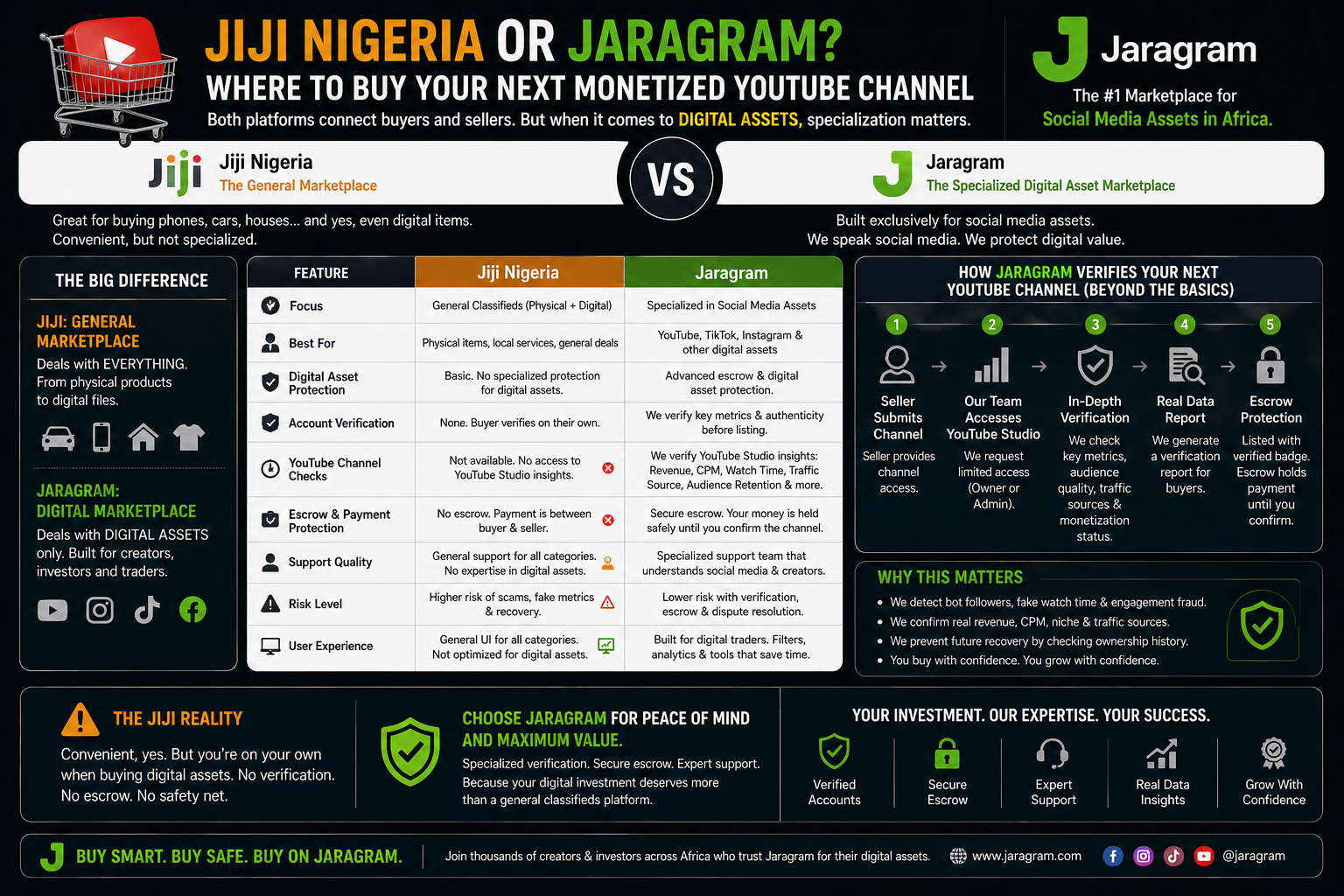
One Platform Sells Everything. The Other Knows Exactly What You Are Buying. That Difference Costs Money.
Jiji Nigeria is the most successful online classifieds platform in the country. Walk through any Nigerian city, and you will find people browsing Jiji for apartments, cars, phones, furniture, job listings, and yes, social media accounts. The platform's category structure covers an almost absurd range of products. On the same website where someone lists a used generator, another person lists a monetized YouTube channel. Jiji connects buyers and sellers across every imaginable category, and it does so with the familiarity that comes from being a household name in Nigerian e-commerce.
This is Jiji's strength, and it is also exactly why buying a monetized YouTube channel on Jiji is fundamentally different from buying one on JaraGram. A platform that sells everything cannot be excellent at verifying any specific thing. The infrastructure that works for a physical product, meet the seller, inspect the item, exchange cash, does not translate to a digital asset where the value is invisible to the naked eye and the risks are technical rather than physical.
When you spend hundreds of thousands of Naira on a YouTube channel, you are not buying a physical object you can hold and inspect. You are buying a collection of metrics, an audience relationship, a content library, and a monetization status that exists entirely on Google's servers. Verifying what you are actually buying requires access to the platform's backend analytics, an understanding of what genuine engagement looks like, and the ability to spot the difference between an organically monetized channel and one that was approved through artificial means and risks demonetization.
Jiji's support team handles disputes about damaged furniture and phones that do not power on. JaraGram's support team handles disputes about YouTube Studio analytics, subscriber authenticity, and monetization status verification. The difference between these two types of expertise is the difference between buying with confidence and buying with hope.
The Digital Versus Physical Marketplace Divide
To understand why a specialized marketplace matters, you need to understand what makes digital asset transactions fundamentally different from physical product transactions.
When you buy a phone on Jiji, the verification process is physical and immediate. You meet the seller. You hold the phone. You power it on. You check the screen, the camera, the battery health. You confirm the IMEI is clean. The transaction completes when you hand over cash and receive the product. If something is wrong, you know within minutes. The evidence of the problem is physical and demonstrable.
When you buy a YouTube channel, none of this applies. You cannot hold the channel in your hand. You cannot power it on and immediately verify everything. The value of the channel resides in metrics that live on YouTube's servers: watch time, subscriber authenticity, revenue history, content ID claims, copyright strikes, and community guideline standing. These metrics can be misrepresented by a seller who shares selective screenshots. They can be artificially inflated by bot subscribers that will disappear when YouTube conducts its periodic purge. They can be hiding a copyright strike that is one violation away from demonetization.
A general classifieds platform is not built to verify these things. Jiji's dispute resolution system is designed for physical products. The buyer claims the product was not as described. The seller claims it was. The platform reviews messages and photos. This framework does not accommodate a dispute where the evidence is a YouTube Studio dashboard screenshot that requires specialized knowledge to interpret correctly.
This is not a criticism of Jiji. The platform is excellent at what it was designed to do. It was simply not designed to verify the authenticity of YouTube channel metrics. Expecting a general classifieds platform to provide specialized digital asset protection is like expecting a general practitioner doctor to perform heart surgery. The expertise is different, and the stakes of getting it wrong are similarly serious.
What YouTube Studio Actually Reveals
The centerpiece of any YouTube channel purchase is the YouTube Studio dashboard. This is where the channel's real performance data lives. It is also where sellers attempting to misrepresent a channel will selectively share information that paints a misleading picture.
A legitimate verification of a YouTube channel requires examining the YouTube Studio analytics in real time, not through screenshots that could be from any channel or any time period. The verification must confirm that the subscriber count matches what was advertised, that the subscribers are real people rather than bots, and that the subscriber growth curve is organic rather than showing suspicious spikes.
The verification must examine the revenue tab to confirm that the channel is genuinely monetized through the YouTube Partner Program, not through a Content ID claim or a multi-channel network arrangement that could change after the sale. The monthly revenue history should show consistent earnings rather than a suspicious spike followed by a decline. A channel earning $500 monthly for six months is a stable asset. A channel that earned $2,000 last month after earning $100 for the previous five months needs investigation.
The verification must check the content library for copyright claims and community guideline strikes. A copyright claim on a single video might be manageable. A channel with multiple unresolved copyright claims or a community guideline strike is one violation away from losing monetization entirely. The buyer who does not check this before purchasing is buying a channel that could be demonetized the day after the sale.
The verification must examine the audience demographics and watch time sources. A channel with subscribers predominantly from countries with low ad rates will earn less than a channel with subscribers from high-CPM markets. A channel where most watch time comes from YouTube search is more stable than a channel where most watch time comes from external websites that could stop sending traffic at any time.
These are the technical details that determine whether a YouTube channel is worth the asking price. A general classifieds platform administrator cannot verify these things because they lack the specialized knowledge, the verification protocols, and the platform relationships. They are not equipped to distinguish between an organic subscriber growth curve and a bot-inflated one. They do not know what a healthy revenue per mille looks like for different content categories.
How JaraGram Verifies What Jiji Cannot
JaraGram's support team operates with a different mandate and a different skill set. When a monetized YouTube channel is listed on JaraGram, the verification process is built around the specific technical characteristics of YouTube as a platform.
The listing verification includes a real-time review of YouTube Studio analytics during a screen share session or through platform-integrated verification tools. The support team is trained to identify the red flags that indicate bot subscribers, artificial watch time, and monetization irregularities. They know that a sudden subscriber spike of 10,000 followers in a single day without a corresponding viral video is a sign of purchased subscribers. They know that watch time concentrated in a single geographic region that does not match the content language suggests artificial traffic.
Before a transaction completes, the buyer is provided with verified analytics data generated through the platform's verification process, not through seller-provided screenshots. The buyer can review the subscriber growth history, the revenue history, the copyright and strikes status, and the audience demographics with confidence that the data has been independently verified.
During the transfer process, JaraGram's support team guides both parties through the complete YouTube channel handover. This includes transferring the Google account that owns the channel, ensuring that the Original Email and recovery phone number are updated to the buyer's details, and confirming that the buyer has full administrative access to YouTube Studio before the escrow releases funds. These steps, standard on a specialized platform, are simply not part of the transaction process on a general classifieds website.
If a dispute arises, the support team adjudicates based on platform-specific evidence. The verification data gathered during the listing process becomes the baseline against which the buyer's claims are evaluated. If the seller represented a channel as earning $500 monthly and the verified analytics show $200 monthly, the dispute resolution is straightforward because the platform verified the data independently rather than relying on seller screenshots.
What Happens When a Channel Goes Wrong
Consider a scenario that illustrates the difference between buying on a general classifieds platform and a specialized marketplace.
A buyer purchases a monetized YouTube channel for ₦500,000 on a platform without specialized verification. The seller provided screenshots showing 50,000 subscribers and $600 monthly revenue. The buyer pays, receives the channel credentials, and logs into YouTube Studio. The subscriber count is 50,000, but 15,000 of those subscribers came from a single source in a single week four months ago, a classic bot subscriber pattern. YouTube's next purge will remove those subscribers. The revenue is $600 monthly, but $400 of it comes from a single video that went viral briefly and has now stopped generating views. The channel's real earning potential is closer to $200 monthly.
The buyer has been misled, but not in a way that is obvious to a general classifieds dispute system. The seller provided screenshots that were technically accurate at the moment they were taken. The subscriber count and revenue numbers match the screenshots. The fact that the composition of those numbers tells a different story is invisible to a platform administrator who does not understand YouTube analytics.
On JaraGram, this scenario is caught before the transaction completes. The platform's verification process flags the anomalous subscriber spike and the revenue concentration risk. The buyer sees verified analytics, not seller-selected screenshots. The buyer can make an informed decision, negotiating a lower price that reflects the channel's real value or walking away from a misrepresented asset entirely.
The Jiji Advantage: When General Classifieds Make Sense
Jiji is not a bad platform. For many types of transactions, it is the best option available. If you are buying a phone, a car, or furniture, Jiji's massive user base, local meetup options, and category breadth make it the obvious choice. The platform is also useful for discovering that monetized YouTube channels are available for purchase in the first place. Many buyers first learn about the account trading market through Jiji listings.
But discovery and purchase are different activities. The smart approach is to use Jiji for discovery, browsing the listings to understand what is available and at what price points, and then complete the actual transaction on a platform designed to protect digital asset buyers. You would not buy a house based on photos without a structural survey. You should not buy a YouTube channel based on screenshots without independent analytics verification.
The Specialized Support Difference
The support team distinction matters beyond the verification stage. After purchasing a YouTube channel, buyers often have questions about managing their new asset. A general classifieds support team cannot advise on YouTube monetization policies, content strategy, or audience retention. Their expertise ends when the transaction completes.
JaraGram's support team operates within the social media ecosystem continuously. They understand YouTube's evolving monetization requirements, the impact of algorithm changes on channel revenue, and the best practices for transferring and securing a purchased channel. When a buyer encounters an issue months after purchase, the support team has the context and expertise to assist because they understand the asset class.
This ongoing expertise is part of what distinguishes a specialized marketplace from a general classifieds platform. You are not just buying a channel. You are buying into a marketplace ecosystem that understands what you bought, how to protect it, and how to resolve problems specific to the asset class. That ecosystem does not exist on a platform where YouTube channels are listed alongside used generators and rental apartments.
The channel you buy represents real money invested. The verification protecting that investment should come from people who understand exactly what they are verifying. In the choice between a platform that sells everything and a platform that specializes in exactly what you are buying, the specialized platform is not just the safer option. It is the only option designed to verify what you are actually purchasing.