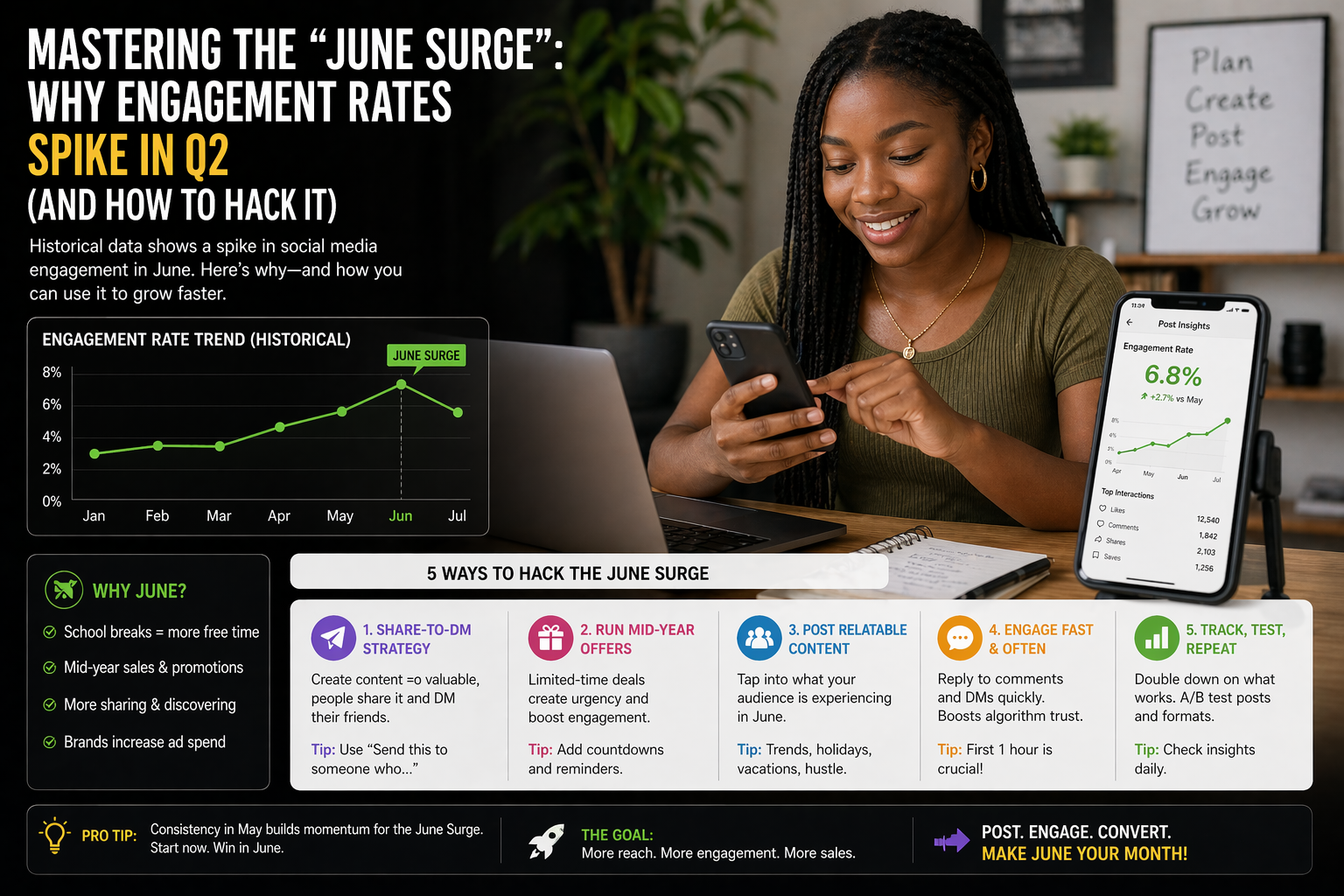
Every June, Social Media Wakes Up. Here Is How to Ride the Wave Before Your Competitors Do.
If you have been managing social media accounts for more than a year, you have probably noticed something strange happens every June. Your posts get more comments. Your Stories see higher completion rates. Content that would normally get 50 likes suddenly pulls in 200. It feels like the algorithm has become generous overnight.
It is not luck, and it is not the algorithm randomly favoring you. This is the June Surge, a predictable, data-backed spike in social media engagement that happens every year during the second quarter, and the creators who understand why it happens and how to hack it capture disproportionate growth during this window.
Social media algorithms in 2026 are more responsive to genuine user behavior signals than ever before. When user behavior shifts, the algorithm follows. June brings a confluence of behavioral shifts that create a six-week window of elevated engagement across Instagram, TikTok, and Facebook. This guide breaks down the data behind the surge, explains the user psychology that drives it, and gives you specific share-to-DM strategies that turn the surge into follower growth and sales.
The Data Behind the June Surge
Multiple studies tracking social media engagement across platforms confirm a consistent Q2 pattern. Engagement rates climb beginning in late May, peak through June, and remain elevated into early July before normalizing in August.
The numbers are significant. Instagram engagement rates in June average between 15% and 25% higher than in January and February. TikTok watch time increases as users have more leisure hours and spend them scrolling. Facebook group activity spikes as people with more free time return to community discussions. LinkedIn engagement interestingly dips, which makes sense given that professional networking takes a backseat when decision-makers are on holiday.
This is not a 2026 anomaly. The pattern has held for years. What has changed is the algorithm's sensitivity to it. Modern recommendation engines detect when a user's behavior changes. If a user who normally scrolls for twenty minutes daily suddenly scrolls for forty-five minutes, the algorithm serves them more content from accounts they do not yet follow. This is the window where organic reach expands because the platform has more attention to distribute and is actively looking for accounts to distribute it to.
For Nigerian creators, this pattern is amplified by local factors. Schools break for mid-year holidays. University students finish exams and reclaim their scrolling hours. Mid-year sales from e-commerce brands flood platforms with promotional content that users engage with heavily. The entire content ecosystem becomes more active, and that rising tide lifts the boats that are positioned to catch it.
Why Users Engage More in June
Understanding the psychology behind the surge lets you create content that captures it. Users engage more in June for three primary reasons.
The first is time availability. The single biggest constraint on social media engagement during the rest of the year is that people are busy. They scroll briefly between tasks and rarely have the mental bandwidth to leave thoughtful comments, share content, or participate in discussions. In June, that constraint loosens. School breaks free up hours for younger users. Workplaces often slow down as colleagues take holidays. The result is more time spent on platform and more willingness to engage deeply rather than scroll passively.
The second is mood. Seasonal mood research consistently finds that people report higher energy and more positive affect during early summer months. Users in a good mood are more likely to engage positively with content, leave encouraging comments, and share things that made them feel good. Content that is uplifting, humorous, or inspiring overperforms in June relative to content that is negative or fear-based.
The third is commercial intent. June is the gateway to mid-year sales from major e-commerce platforms and brands. Users scrolling with shopping intent are more likely to engage with product content, save posts for later purchase consideration, and share deals with friends. This commercial engagement signals to the algorithm that the user is in a high-intent mode, which triggers more product and recommendation content in their feed.
The Share-to-DM Strategy That Converts the Surge
Knowing that engagement spikes is useful. Having a specific tactic that converts that spike into follower growth and revenue is what separates professionals from hobbyists. The most effective June surge tactic in 2026 is share-to-DM.
Share-to-DM is the practice of designing content specifically to be shared by one user to another via direct message. This is not the same as content designed for public comments. A user who leaves a public comment gives you one engagement signal. A user who shares your post with three friends via DM gives you multiple signals and exposes your account to three potential new followers who receive the recommendation from someone they trust.
The algorithm weights DM shares more heavily than almost any other engagement metric. A share signals to the platform that your content was valuable enough for someone to personally recommend it. The recipient of that share typically opens it, watches it fully, and often engages because it came from a friend. This behavioral chain is algorithmic gold.
Here are four specific share-to-DM formats calibrated for the June 2026 surge.
#
The Relatable Observation Post
This format is simple but consistently effective. You create a post that captures an observation so specific and relatable that users instinctively think of the person who embodies it and send it to them.The structure is usually a simple image or short video with text overlay making the observation, and a caption that adds context without diluting the share impulse. The key is specificity. A post saying "When you finally finish exams and your brain stops working" is fine. A post saying "That moment when you close your last exam booklet and just stare at the wall for ten minutes because your brain has officially resigned" is better because it captures the exact feeling, and the specificity triggers the thought: I need to send this to someone who just finished exams.
These posts do not need to be about your niche directly. They need to be about your audience's experience. A real estate account can post relatable observations about the frustrations of house hunting. A fashion account can post about the chaos of shopping sales. The goal is to get your existing followers to share your content with their friends, introducing those friends to your account.
#
The Debate Prompt Designed for DM Discussion
Some topics are too controversial for public comments but perfect for private discussion. A well-designed debate prompt that users want to discuss but do not want to attach their name to publicly drives massive DM shares.Your caption or video should pose a specific, slightly provocative question related to your niche. A personal finance account might post: "Unpopular opinion: buying a car before you have six months of emergency savings is a financial mistake. Discuss." Users who agree will share it with friends saying "Finally someone said it." Users who disagree will share it saying "This is nonsense, what do you think?" Both behaviors are wins for your reach.
The key to making this work without attracting negativity is to phrase the prompt as an opinion open to discussion, not as an attack. You are starting a conversation, not starting a fight. The DM share happens because people want to discuss the topic privately before potentially commenting publicly.
#
The Utility Save-and-Share
Content that is practically useful outperforms content that is merely entertaining for DM shares. A user who finds genuine utility in your post will often save it for personal reference and share it with someone they know who needs the same information.Create content that solves a specific problem or teaches a specific skill in a format that is easy to consume and apply. A checklist, a short step-by-step guide, a comparison table, or a resource list all fit this format.
For example, if you run an account about making money online, a post titled "5 apps that pay you within 24 hours of completing tasks" will be saved by users who want to try them and shared with friends who are also looking for income opportunities. If you run an account about social media growth, a post showing exactly which metrics matter in the 2026 algorithm will be saved by other creators and shared in their collaboration group chats.
The utility post's long lifespan is an additional benefit. While a relatable observation might have a 48-hour engagement window, a utility post can be discovered via search and shared for months after publication. During the June surge, the initial spike of shares is amplified by the elevated platform activity, but the post continues working long after the surge ends.
#
The Interactive Story Series with DM Response
Instagram Stories have higher DM response rates than feed posts because the barrier is lower. A user watching your Story can reply with a single tap without leaving the Story interface. Design Story series during June specifically to push users into your DMs.Run a poll that asks a question where users will want to explain their answer. "Do you think buying Instagram accounts is a smart investment? Yes or No." After they vote, the next Story slide says: "If you voted yes, tell me why in the DMs. I am compiling the best responses for a post." This gives users a reason to DM you beyond just reacting.
Run a Q&A where you invite specific, interesting questions. The users who submit questions are now in your DMs, which means they will see your future Story replies and continued conversation. This deepens the relationship beyond the passive follower connection.
The DM interaction also signals to Instagram that you have an active, reciprocal relationship with your followers, which improves your content's ranking in their feed. Every DM reply you send is a positive engagement signal that benefits your overall account health.
How to Prepare Your Content Calendar for the June Surge
The creators who benefit most from the June surge are not the ones who frantically post more when they notice engagement climbing. They are the ones who prepared their content in May and simply execute during the surge window.
Map out your June content calendar now. Identify which share-to-DM formats you will use each week. Batch-create the content before the surge begins. This frees you to spend June engaging with the increased comment and DM activity rather than scrambling to create content while the window is open.
Increase your posting frequency during June if your content quality can sustain it. The expanded attention pool means more posts can perform well without cannibalizing each other. Posting five times weekly instead of three during peak engagement weeks captures additional reach.
Schedule your most important commercial content for the last two weeks of June and the first week of July. If you are selling accounts on JaraGram, promoting a product, or driving sign-ups for something, this is the window. The engagement momentum is at its peak, and the mid-year shopping intent is still strong.
After the surge, analyze what worked and document it for next year. Which share-to-DM formats drove the most new followers? Which topics generated the most saves? The June surge is a predictable annual event. The insights you gather this year become your playbook for next year.
The Surge Is Coming Whether You Prepare or Not
June will arrive on schedule. Users will open their apps more often, scroll longer, and engage more generously. Your competitors will notice their numbers going up and assume they are doing something right. You will know it is the surge, and you will have content specifically designed to convert that temporary attention into permanent followers and repeat customers.
The share-to-DM strategy works because it leverages the surge's core dynamic. People have more time, they are in a better mood, and they are more willing to share things with friends. Your job is to give them things worth sharing. Do that consistently for the six-week surge window, and your account will exit July significantly larger and more engaged than it entered May.