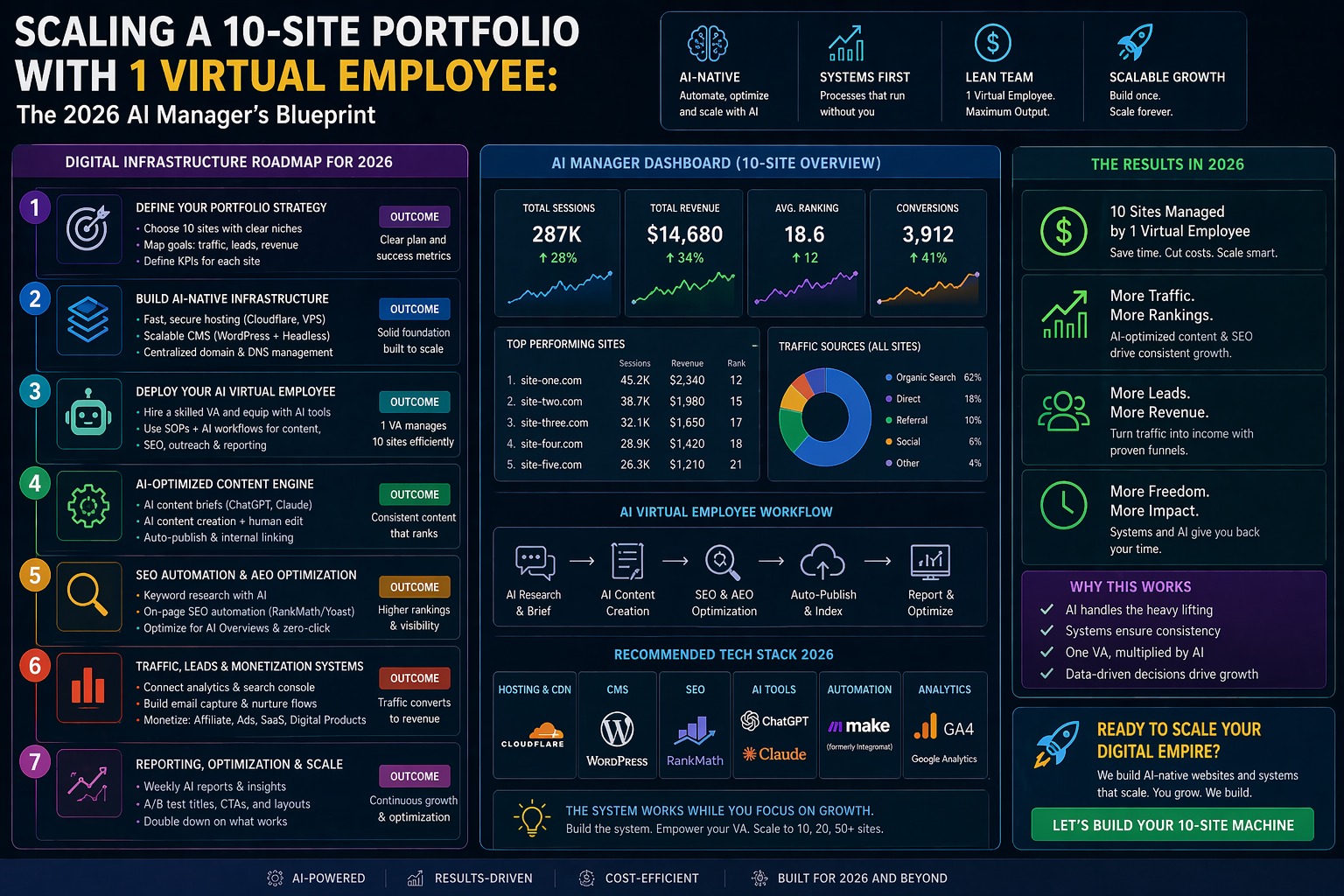
One Person. Ten Websites. Zero Chaos. Here Is the Blueprint That Makes It Possible.
The old way of running multiple websites was a grind. You managed each site separately. You hired a writer for each one. You logged into ten dashboards, checked ten analytics accounts, and burned through your day doing manual work that never ended. Most people who attempted it either burned out or let half their portfolio die from neglect.
In 2026, that equation has changed completely. The arrival of mature AI agents and orchestration tools means a single operator with one skilled virtual employee can now manage a profitable ten-site portfolio without losing their sanity. As *SEO Content for SaaS That Still Drives Revenue in 2026* confirms, the operators winning right now are not those who work harder. They are the ones who built a smarter digital infrastructure from day one.
This blueprint is exactly that. A step-by-step roadmap for building the AI-native system that lets one person and one assistant run an entire content and commerce portfolio. If you have been looking for the bridge between a single profitable side hustle and a true portfolio business, this is it.
What Is a Digital Infrastructure Roadmap?
A digital infrastructure roadmap is a documented system that defines which tools, automations, and people handle every recurring task across your portfolio. The goal is simple: no task requires the business owner's manual input unless it is a strategic decision.
Once this infrastructure is in place, adding an eleventh site to the portfolio does not add proportional work. It is the difference between carrying ten buckets of water by hand and building a pipeline. The pipeline costs more upfront but pays forever.
This is the same principle that makes data reselling a scalable hustle. You build the system once. The transactions flow through it. Your job becomes watching the dashboard, not processing every order.
The Digital Infrastructure Roadmap for 2026
Follow this step-by-step system to go from scattered sites to a managed portfolio.
#
Step 1: Centralize Everything on a Single Dashboard
The first enemy of a portfolio operator is fragmentation. You cannot manage ten separate hosting accounts, ten WordPress installations, and ten analytics logins without something slipping. Centralization is non-negotiable.Your first infrastructure decision is choosing a management layer that sees everything in one place. The practical setup for May 2026 looks like this:
The test that your centralization is working: you can see every site's traffic, uptime, and revenue in under 60 seconds from opening your laptop.
#
Step 2: Build One Master Content Engine
Content is still the fuel for organic traffic, but you are not writing ten blogs manually. Your infrastructure needs a content engine that produces quality drafts across all sites using AI agents orchestrated properly.The setup involves three connected components:
This single content engine serves all ten sites without multiplying the work. Adding a new site just means adding its keywords to the research queue.
#
Step 3: Automate Internal Linking Across the Portfolio
Internal linking is one of the highest-ROI SEO activities, and it is also one of the most tedious to do manually. Your infrastructure should automate this.Use a WordPress plugin like Link Whisper or an AI-powered interlinking tool that scans all published content across your portfolio and suggests relevant internal links automatically. When you publish a new post about buying social media accounts safely, the tool should automatically suggest linking to your guide on how Instagram account prices are determined.
This cross-site linking builds topical authority across the entire portfolio without you or your virtual employee spending hours manually inserting links.
#
Step 4: Deploy One Unified Monetization Dashboard
Revenue tracking across ten sites is a headache if each site uses different ad networks, affiliate programs, and payment processors. Unify revenue tracking into a single dashboard.The practical setup:
You and your virtual employee review one revenue dashboard weekly, not ten.
#
Step 5: Set Up Proactive Monitoring and Alerts
A ten-site portfolio is only as strong as its uptime and security. Your infrastructure must watch the sites so you do not have to.Install uptime monitoring via a tool like UptimeRobot or BetterStack. Connect it to a Telegram alert bot that pings you and your virtual employee instantly when a site goes down. For security, use a single patch management system that auto-updates WordPress core files, themes, and plugins. Wordfence Central lets you manage security across multiple WordPress sites from one panel.
You should know about a problem within sixty seconds of it happening, not when you casually check the site three days later and find it has been down the whole time.
The Virtual Employee: Who They Are and What They Do
The entire infrastructure above is built to be operated by you and one skilled virtual employee. This person is not a random assistant you found on a cheap marketplace. They are a trained operator who understands content management, basic SEO, and AI tools.
Their weekly responsibilities under this blueprint:
You handle strategy. You decide new sites to launch, new keywords to target, and new monetization paths to test. Your virtual employee handles operations. This separation is what stops a portfolio from becoming a prison.
This model is directly comparable to how freelancers on Fiverr and Upwork scale beyond solo operation. They start as the service provider, then graduate to being the manager of a system that delivers the service.
Why This Blueprint Wins in 2026
The operators still grinding manually across multiple websites are competing against those who built this infrastructure. That competition is not fair. One side is trading time for output. The other has built a machine where time invested stays flat while output scales.
The tools to build this infrastructure are not expensive. Most of the AI and automation platforms discussed have free tiers or monthly costs far below what a single profitable site generates. The real investment is the upfront decision to stop doing things the old way and build the pipeline instead.
Your ten-site portfolio does not need ten employees. It does not even need you to work ten-hour days. It needs this blueprint, implemented once, operated by one capable person, and watched with the calm confidence that comes from knowing the machine is running exactly as designed.