One Platform Looks Beautiful. The Other Makes You More Money Across Every Channel.
Sebuda has arrived. The platform's design language, clean layouts, smooth transitions, and a modern aesthetic, signals that someone thought carefully about the user experience. Browsing listings on Sebuda feels like scrolling through a well-designed app rather than navigating a utilitarian marketplace. For Instagram account sellers, the platform has built a growing reputation as a legitimate destination where quality listings attract serious buyers.
The crypto-native payment infrastructure is another point in Sebuda's favor. Smart contract escrow eliminates the delays and fees associated with traditional payment processors. For sellers who already operate in the crypto ecosystem and prefer to keep their funds in USDT or other digital assets, Sebuda removes conversion steps that other platforms add.
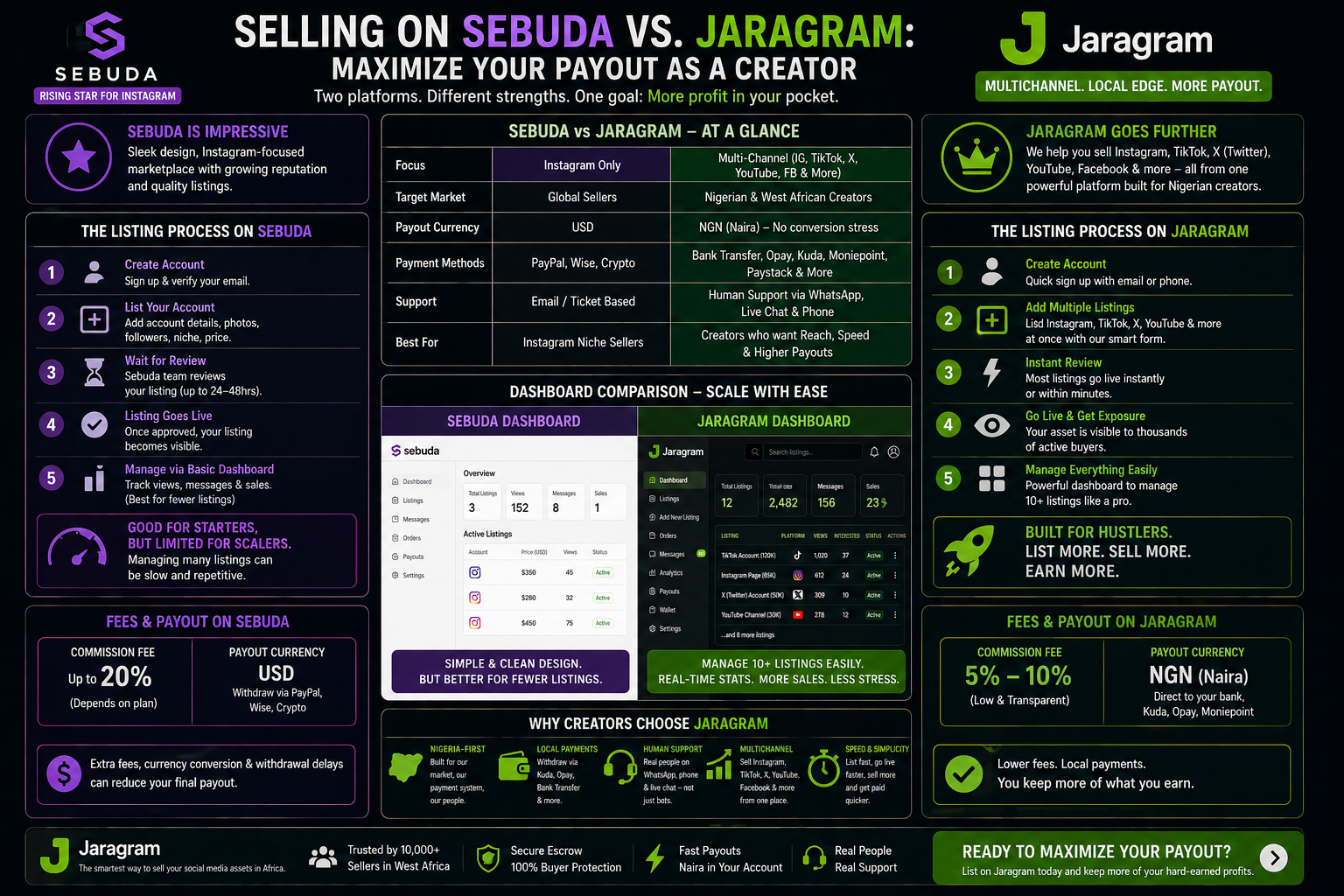
But here is what the sleek design does not tell you. Sebuda is primarily an Instagram marketplace. Its seller tools, its buyer community, and its listing optimization features are built around Instagram as the core asset class. If Instagram accounts represent your entire flipping inventory, Sebuda deserves serious consideration. If your creator portfolio spans TikTok, X, YouTube, and Telegram alongside Instagram, a single-channel platform leaves money on the table for every asset class except one.
The Listing Process: Two Different Philosophies
The way a platform structures its listing process reveals its assumptions about who its sellers are and how they operate.
Creating a listing on Sebuda is a polished, guided experience. The platform walks you through a step-by-step form optimized for Instagram accounts. You input the handle, the follower count, the niche category, the engagement metrics, and the asking price. The interface is clean, the fields are well-labeled, and the process feels premium. For a seller listing one Instagram account, it is a pleasant experience.
Now imagine you are a serious flipper managing a portfolio of fifteen accounts across four platforms. You have five Instagram accounts, four TikTok accounts, three X accounts, two YouTube channels, and a Telegram community to list. On a platform optimized for single Instagram listings, you are going to complete that guided step-by-step form fifteen times. Each time, you re-enter similar information in fields designed for Instagram metrics that do not map cleanly to TikTok views or Telegram member counts.
JaraGram's listing dashboard was built for portfolio sellers. The interface assumes you might be managing multiple listings across multiple platforms simultaneously. The listing creation process is structured but efficient, with smart defaults that reduce repetitive data entry and platform-specific fields that adapt based on what you are selling. An Instagram listing shows fields for follower count, engagement rate, and niche category. A TikTok listing shows fields for video views, creator fund eligibility, and account age. An X listing shows fields for impression metrics and verification status.
This adaptive listing interface means you are not fighting against Instagram-optimized forms when you are trying to list a TikTok account. The relevant fields appear. The irrelevant fields do not. The listing accurately represents the asset you are selling because the platform was built to understand that different social media platforms require different types of information to convey value to buyers.
Managing a Portfolio: The Dashboard Difference
The single-listing experience matters for the casual seller. The portfolio management experience matters for the professional flipper. This is where the platform comparison shifts from feature checklists to workflow impact.
On Sebuda, managing multiple active listings means navigating between individual listing pages. Each listing has its own management view where you can check status, respond to buyer inquiries, and adjust pricing. If you have ten active listings, you have ten pages to monitor. A buyer inquiry on listing three requires navigating to listing three's page, reading the message, responding, and then navigating back to check on listing seven. The process is functional but fragmented.
JaraGram's seller dashboard consolidates portfolio management into a single interface. All active listings appear in a unified view with real-time status indicators. A listing with a new buyer inquiry shows a notification badge directly in the dashboard, not buried in a separate messaging tab. You can scan your entire portfolio's status, pending, in escrow, sold, price adjusted, in seconds from one screen.
Bulk actions become possible. You can adjust pricing across multiple listings responding to a market shift without opening each listing individually. You can pause underperforming listings and promote ones gaining traction. The dashboard treats your portfolio as a portfolio, not as a collection of separate pages that happen to share a login.
For a seller managing ten or more active listings, this consolidated management approach saves hours per week. Those hours compound into more listings created, more buyer inquiries answered, and more transactions closed. The dashboard is not a cosmetic feature. It is a revenue multiplier for volume sellers.
Beyond Instagram: The Multichannel Reality
The Nigerian social media trading market is not an Instagram market. It is a multichannel market where value shifts between platforms as monetization opportunities evolve.
TikTok accounts have surged in value as the TikTok Creativity Program opened revenue streams for Nigerian creators. An aged TikTok account with creator fund eligibility commands prices that rival or exceed comparable Instagram accounts. Sellers who can source, grow, and flip TikTok accounts alongside Instagram accounts have a diversified inventory that protects them when one platform's market softens.
X accounts have quietly become valuable assets as the platform's monetization features have expanded. A verified X account with a substantial following in a specific niche, tech, finance, entertainment, is a distribution channel that businesses will pay to access. The X account market in Nigeria is smaller than Instagram or TikTok but growing, and the sellers who establish themselves early capture the highest margins.
YouTube channels with existing monetization represent the highest-value single transactions in the social media asset market. A monetized channel with consistent revenue history can sell for significant amounts, and the verification requirements for YouTube purchases are more technically demanding than for other platforms. A marketplace that understands YouTube Studio analytics and monetization policy is essential for these transactions.
Telegram communities, while smaller in transaction volume, have dedicated buyer pools willing to pay premium prices for established groups and channels with engaged memberships.
A marketplace that supports only Instagram is asking sellers to ignore four of the five active asset classes in the Nigerian market. A marketplace built for multichannel trading recognizes that a seller's TikTok account is just as valuable as their Instagram account and provides the same listing quality and buyer visibility for both.
The Payout Reality
Sebuda's crypto-native payout system works beautifully for sellers already operating in crypto. If you receive USDT, hold USDT, and spend USDT, the settlement is seamless. The smart contract releases funds, and they appear in your wallet. No bank delays. No currency conversion within the platform.
For the Nigerian seller who needs Naira at the end of the transaction, the crypto intermediary adds a step rather than removing one. The USDT arrives in your wallet. You then need to convert it to Naira, either through P2P trading or a centralized exchange. The conversion rate you get depends on market conditions at the moment of conversion. The P2P transaction carries its own risks of counterparty fraud or bank account flagging. The crypto payout that seemed like an advantage becomes another conversion step with its own friction.
JaraGram's Naira settlement removes every conversion step. You list in Naira. The buyer pays in Naira. The escrow holds Naira. Your payout lands in your Kuda, Opay, or traditional bank account as Naira. There is no crypto volatility between sale and settlement. There is no P2P counterparty risk. There is no exchange withdrawal limit delaying your access to funds. The money arrives in the form you need to spend it.
For volume sellers closing multiple transactions monthly, this settlement simplicity compounds. Every conversion step eliminated is time saved, risk avoided, and fee retained as profit.
Where Sebuda Wins
Sebuda deserves its rising reputation for a specific type of seller. If your inventory is exclusively Instagram accounts, and you prefer crypto settlement, and you value a polished single-listing experience over portfolio management tools, the platform is a legitimate and growing marketplace with a design quality that makes daily use pleasant.
The crypto escrow model is genuinely innovative. Smart contract settlement eliminates the need to trust a platform's internal escrow management. For sellers who are philosophically aligned with decentralized finance and want their transactions to reflect that alignment, Sebuda offers something no traditional escrow platform can match.
The platform is also building a community around Instagram account trading specifically. The buyer pool is concentrated on Instagram assets, which means Instagram listings may receive more targeted attention than on a generalist or multichannel marketplace. For an Instagram specialist, this concentrated buyer attention has value.
Where JaraGram Wins for Nigerian Creators
JaraGram wins on portfolio scale, multichannel reach, and settlement practicality.
If you are a serious flipper managing accounts across TikTok, Instagram, X, YouTube, and Telegram, JaraGram is the only platform that treats all your assets as first-class listings with platform-specific fields, relevant buyer audiences, and appropriate verification. You are not contorting a TikTok account into an Instagram listing form. You are listing each asset on a platform that understands what makes it valuable.
If you need Naira settlement without intermediate conversion steps, JaraGram's local payment integration gets your money into your bank account faster and with fewer deductions than any platform that settles in crypto or dollars. For the Nigerian creator economy, where Naira is how bills are paid and inventory is purchased, this settlement practicality is not a luxury. It is a requirement.
If you are managing a portfolio large enough that individual listing pages become a time tax, JaraGram's unified dashboard turns portfolio management from a chore into a workflow. The hours saved on navigation and status checking become hours invested in sourcing new accounts, improving existing listings, and building buyer relationships.
The Platform That Fits Your Ambition
The platform choice reflects the scale of your ambition. A seller with one Instagram account to flip will be well served by Sebuda's polished single-listing experience. A seller building a portfolio business across multiple platforms, managing twenty listings, optimizing for Naira profitability and transaction velocity, needs a platform built for that scale.
JaraGram's listing dashboard, multichannel architecture, and local settlement infrastructure were designed for the seller who treats social media asset flipping as a business, not a transaction. The tools exist to manage complexity. The platform categories exist because Nigerian traders trade across every platform where attention can be monetized. The settlement exists in Naira because that is the currency the Nigerian creator economy actually runs on.
The sleek design of a single-channel platform is appealing until you need to list a TikTok account and realize the form does not have fields for the metrics that matter. The polished experience of listing one account is satisfying until you need to manage fifteen and realize each one lives on its own isolated page. Choose the platform that matches the scale at which you actually operate.