The Way You Receive Business Payments Is About to Change Forever. Here Is How to Switch Before the Deadline.
Nigerian P2P crypto traders have operated in a gray zone for years. The arrangement worked because it had to. Banks were hostile to crypto transactions. Traditional payment rails were too slow and too expensive for international business. So traders built an entire parallel financial system on platforms like Binance P2P, using USDT as a proxy for dollars and moving value through hundreds of thousands of daily trades.
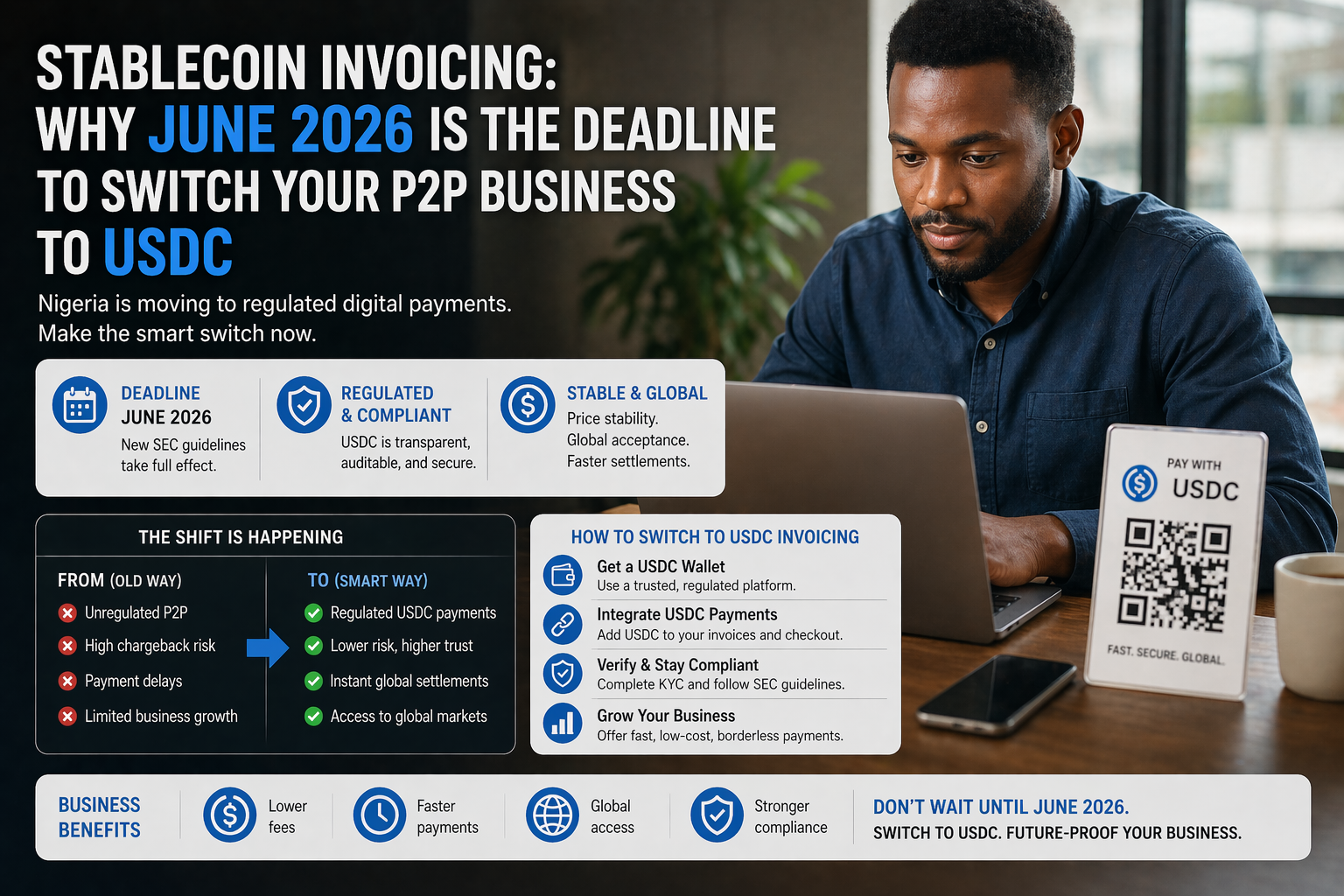
That era is ending. Not because P2P trading is being banned, but because the Nigerian financial regulator is finally drawing a clear line between unregulated retail P2P and regulated business-to-business stablecoin payments. The June 2026 deadline is not a rumor. It is the culmination of policy direction that has been building since the Central Bank's initial crypto circular and the SEC's subsequent digital asset framework.
For anyone running a business that receives international payments, issues invoices to foreign clients, or trades crypto as a primary income source, the next few weeks represent a critical transition window. Those who switch to regulated USDC invoicing now will operate with full compliance and banking integration. Those who wait risk account freezes, payment disruptions, and lost business relationships.
This guide explains what is changing, why USDC specifically is the stablecoin being favored, and exactly how to switch your invoicing and payment infrastructure before the June 2026 deadline.
What Has Actually Changed in the Regulatory Landscape
The narrative that Nigeria is anti-crypto is outdated and inaccurate. What has actually happened is a careful separation of use cases. The regulators have studied the difference between speculative retail trading and genuine business payments, and they are regulating them differently.
The SEC's new guidelines, which have been in development through extensive consultation with industry stakeholders, create a framework for regulated digital asset service providers. Under this framework, stablecoins used for business payments and invoicing fall under a different classification from speculative tokens traded on retail P2P platforms.
The Central Bank has also shifted its stance. The previous blanket restriction on banks servicing crypto-related accounts has been replaced with a more nuanced approach. Banks are now permitted to facilitate transactions involving regulated digital assets and licensed virtual asset service providers. A major commercial bank recently launched a stablecoin settlement pilot for business clients, signaling where the entire financial sector is heading.
This regulatory realignment creates a deadline for businesses. By June 2026, the expectation is that businesses receiving international payments via stablecoins should be doing so through regulated channels with proper invoicing, compliance documentation, and banking integration. The unstructured P2P model simply will not meet the new standard.
For traders who have built their livelihoods on P2P crypto trading, this is not a threat but an upgrade. The same way businesses eventually moved from informal cash transactions to proper invoicing and bank transfers, the migration from unstructured P2P to regulated B2B stablecoin payments is a maturation of the market.
Why USDC Specifically Is Being Positioned as the Business Standard
Not all stablecoins are being treated equally under the new framework. USDT, despite its dominance in P2P trading volumes, faces persistent transparency questions. The issuing company has been repeatedly criticized for opacity around its reserve composition and has never completed a full independent audit by a major accounting firm.
USDC, issued by Circle, has taken a fundamentally different regulatory approach. Circle is registered as a money services business with FinCEN in the United States and holds licenses in multiple jurisdictions. The company publishes monthly reserve attestations by a major global accounting firm, confirming that every USDC in circulation is fully backed by cash and short-duration US government securities.
This transparency matters for regulators. When the SEC evaluates which stablecoins can be integrated into the formal financial system for business payments, USDC's audit trail and regulatory registration give it a clear advantage. The stablecoin market as a whole has grown significantly, with rising stablecoin adoption driving business payment volumes globally, and USDC is capturing an increasing share of that business-to-business segment.
For Nigerian businesses, choosing USDC now is a strategic decision aligned with where regulation is clearly heading. It is the stablecoin most likely to maintain uninterrupted banking integration and regulatory approval as the June 2026 deadline crystallizes.
How to Switch Your Business to USDC Invoicing
This is the practical implementation guide. Follow these steps to transition your payment infrastructure before the deadline.
#
Step 1: Separate Your Trading Wallet from Your Business Wallet
The single biggest mistake P2P traders make is running business payments through the same wallet they use for speculative trading. This co-mingling is exactly what regulators are targeting.Create a dedicated USDC wallet for business payments only. A self-custody wallet like Phantom or a reputable exchange-based business account works. This wallet should have a clear, auditable transaction history that shows only business inflows from clients and outflows to your business bank account. If a regulator or your bank ever asks for transaction records, this clean separation protects you.
#
Step 2: Generate Professional Invoices in USDC
Stop sending your clients a wallet address in a WhatsApp message. Start issuing proper invoices.A USDC business invoice should include your registered business name, your business address, your client's name and address, a unique invoice number, the invoice date and payment due date, a clear description of services rendered or products sold, the total amount in both USDC and its Naira equivalent at the invoice date, your dedicated business USDC wallet address, and your bank details for Naira settlement if applicable.
Several invoicing platforms now support crypto payment options, including USDC. Alternatively, a well-formatted PDF invoice generated from a template works perfectly. The key is documentation. Professional invoices demonstrate to regulators, your bank, and the tax authorities that you are running a legitimate business, not engaging in unstructured P2P trading.
#
Step 3: Use Regulated On-Ramp and Off-Ramp Services
The least compliant part of the old P2P model was how funds moved between crypto and Naira. Direct peer-to-peer transfers with strangers created a compliance nightmare because you could never verify the source of the funds you were receiving.Under the new framework, use licensed virtual asset service providers with banking partnerships to convert USDC to Naira. These providers conduct know-your-customer checks, maintain transaction records, and provide the compliance documentation your bank may require.
The fee for using a regulated off-ramp is slightly higher than the best P2P rate. Think of that difference as compliance insurance. It is the cost of knowing your funds will not be frozen and your bank account will not be flagged.
#
Step 4: Maintain Compliance Records
The regulation expects businesses to keep records. For every USDC business transaction, maintain the invoice you issued, the blockchain transaction hash confirming payment, the conversion record when you exchanged USDC for Naira through a regulated provider, and any client correspondence related to the payment.Store these records digitally in a dedicated folder organized by month. This is not paranoia. If your bank queries a large inflow, having these records immediately available means the query is resolved in hours, not weeks. You will also be prepared if tax filing obligations require you to document international income.
#
Step 5: Communicate the Change to Your Clients Proactively
Do not surprise your international clients with a sudden payment method change. Send a brief, professional email explaining that you are transitioning to USDC invoicing to align with updated Nigerian financial regulations, and that this change benefits them because USDC transactions settle faster and with lower fees than traditional international wires.Provide them with your new business wallet address and a sample invoice. Most international clients, especially those in tech, crypto, or digital services, will be familiar with USDC and may even prefer it. Frame the change as a professional upgrade, not a compliance burden.
What Happens If You Wait Past June 2026
The temptation is to keep running the old P2P system as long as it still sort of works. This is a dangerous calculation because the risks compound silently until they trigger suddenly.
Banks are already deploying more sophisticated transaction monitoring systems that flag accounts with patterns indicative of unregulated P2P trading. An account that receives twenty small transfers from twenty different people every day does not look like a business account. It looks like a P2P trading account, and it will be flagged.
When that flag triggers, the bank does not call you for an explanation first. They freeze the account and ask questions afterward. Getting a frozen account reactivated can take weeks or months. During that time, your working capital is trapped, and your business is paralyzed.
Beyond the account freeze risk, there is the commercial risk. Larger international clients are increasingly requiring their vendors to invoice through compliant, auditable channels. If a client asks for your compliance documentation and you cannot provide it because your payment system is informal P2P, you lose the contract.
The deadline is not an arbitrary date on a regulatory calendar. It is the point at which the old way of doing things stops working for serious businesses.
Why This Shift Matters for Nigerian Business Owners
The migration from black market P2P to regulated B2B stablecoin payments is a positive development for Nigerian businesses. It means you can receive international payments in dollars without your bank account being at risk. You can invoice clients professionally and build lasting commercial relationships. You can access business banking services, loans, and credit that were unavailable when your transaction history looked like a P2P trading log.
The traders who will thrive after June 2026 are the ones who treat this deadline as an opportunity to formalize and grow. They will have clean business wallets, professional invoicing systems, regulated banking relationships, and clients who trust their payment infrastructure.
Set up your USDC business wallet this week. Create your invoice template. Choose your regulated off-ramp provider. Inform your clients. The transition is not complicated, but it requires deliberate action. The deadline is coming. The businesses that act now will be the ones still operational, compliant, and growing when the old system winds down.