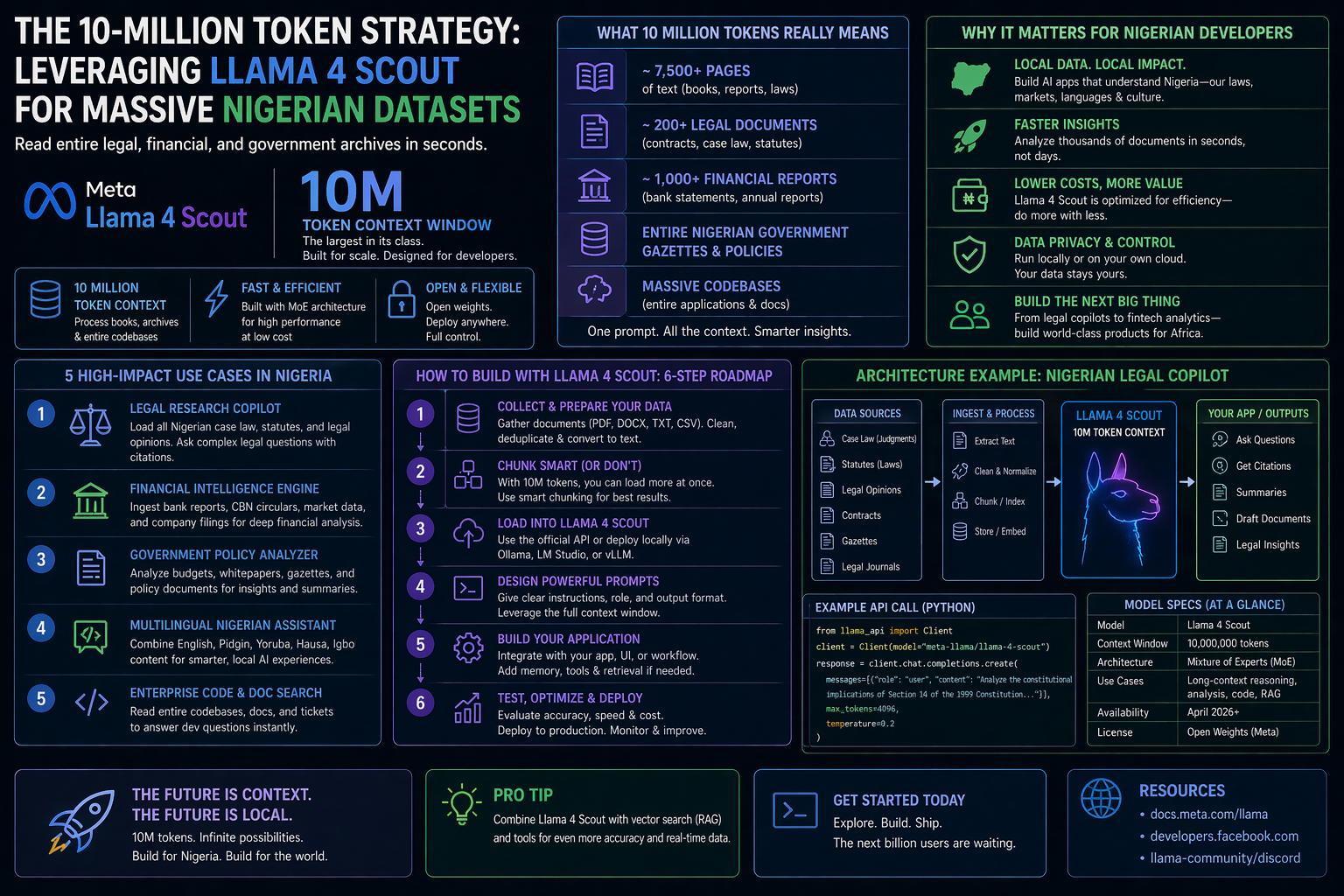
An AI That Reads an Entire Library in One Sitting. Here Is What Nigerian Developers Can Build With It.
In April 2026, Meta quietly released Llama 4 Scout, and most of the conversation missed the point. The headlines focused on benchmark scores and parameter counts. What they should have focused on is the number that actually changes what developers can build: 10 million tokens.
That is the context window. To understand how massive that is, consider that the average novel is about 100,000 tokens. Llama 4 Scout can hold the equivalent of 100 novels in active memory simultaneously. As *Llama 4 Scout: The 10 Million Token Context King* exhaustively documents, this is not an incremental improvement. It is a category shift.
For Nigerian developers building applications on top of large language models, this opens up use cases that were technically impossible six months ago. Applications that can read, understand, and reason across entire archives of Nigerian content, legal records, financial documents, and business data in seconds. This guide is your technical roadmap to what that makes possible and how to start building right now.
Why 10 Million Tokens Changes Everything
Most developers are used to working within severe context constraints. A typical model offers 128,000 tokens. You can feed it a long document and ask questions. But you cannot feed it an entire archive. You cannot feed it a decade of court judgments. You cannot feed it a complete financial audit trail. The context ceiling forced developers to build retrieval systems that grabbed small chunks of data and hoped the right chunk was selected.
At 10 million tokens, retrieval becomes optional for many applications. You simply give the model everything and let it reason across the full dataset. This fundamentally changes application architecture. Instead of a pipeline that searches, retrieves, and then prompts, you build a direct-load-and-query system.
This shift makes possible what was previously only theoretical. A single prompt can now process datasets so large they would crash any earlier model. The same way AI Agent Architects build multi-agent systems for complex business automation, developers using Llama 4 Scout can build single-agent systems that understand entire knowledge domains in one pass.
Use Case One: The Nigerian Legal Research Engine
This is the most immediately valuable application. Nigeria's legal system generates enormous volumes of text. Supreme Court judgments. Court of Appeal rulings. Laws passed by the National Assembly. State-level regulations. Legal practitioners spend hours, often days, manually searching through archives to find relevant precedents.
A developer with Llama 4 Scout can build an application that changes this entirely.
What the app does: A legal professional uploads or links to a repository containing thousands of case files and judgments. The application loads everything into Llama 4 Scout's 10-million-token context window. The lawyer then asks natural language questions: "Show me every Supreme Court judgment since 2015 where the court ruled on electoral matters and ordered a rerun." The model searches across the entire loaded archive and returns relevant cases with citations and reasoning summaries.
Why this was impossible before: Previous models could only search chunks. The lawyer might load five judgments at a time, ask questions, then load the next five. Analyzing thousands of cases required days of manual work. Llama 4 Scout eliminates the chunking step. The entire archive fits in context.
How to build it: Use a Python backend with the Llama 4 Scout API through Meta's hosted service or run the model locally via a provider like Groq or Together AI. The application needs a document ingestion pipeline that converts PDF judgments into clean text. Once converted, load the entire corpus into the context window with a carefully engineered system prompt that instructs the model to behave as a Nigerian legal research assistant with precise citation requirements.
This application alone positions a developer as a technical leader in the legal tech space. Law firms pay handsomely for tools that save associates dozens of research hours per case.
Use Case Two: The Financial Audit and Compliance Analyzer
Nigerian businesses, especially those in regulated industries like fintech and banking, deal with massive compliance documentation. Audit reports spanning years. Transaction logs with millions of entries. Regulatory filings from the Central Bank, SEC, and NDIC.
Llama 4 Scout can process these datasets in their entirety.
What the app does: A compliance officer uploads the company's last five years of audit reports, regulatory correspondence, and internal policy documents. They ask: "Identify every instance where a regulatory body flagged a compliance gap, what the gap was, and whether our documentation shows it was resolved." The model reasons across the full five-year dataset and produces a structured compliance gap analysis.
Why this converts: Compliance is high-stakes and expensive. Missing a single regulatory flag from three years ago can result in fines or license revocation. The current manual process is slow and error-prone. An application that delivers a comprehensive analysis in minutes sells itself.
The technical approach: Prioritize data privacy. This use case involves sensitive financial data, so running Llama 4 Scout locally or through a private cloud instance, rather than a shared API, is essential. The model can run on sufficiently powerful hardware or be accessed through enterprise cloud agreements. The application needs robust data preprocessing to clean and structure financial documents before loading them into context. Build a dashboard that presents findings as structured tables with source document references.
For Nigerian developers already familiar with how P2P crypto platforms process transaction data, this is a natural extension into enterprise tooling.
Use Case Three: The National Policy and Development Tracker
Government ministries, development agencies, and NGOs produce a continuous stream of policy documents, budget statements, project reports, and impact assessments. Researchers trying to understand Nigeria's policy landscape across a sector like healthcare or education must manually synthesize hundreds of documents.
What the app does: A researcher uploads every Federal Ministry of Health policy document, budget allocation statement, and donor agency report from the last decade. They ask: "How has Nigeria's policy on primary healthcare funding evolved since 2016? Show me budget allocation trends and any contradictions between stated policy goals and actual budget releases." The model produces a timeline with citations.
The broader value: This use case extends beyond government. Journalists investigating corruption patterns. NGOs evaluating program effectiveness. Political analysts tracking manifesto promises against delivered projects. The common thread is analyzing vast text archives that no human can read comprehensively.
The Technical Challenge: Context Window Management
A 10-million-token context window is powerful but not magical. Developers must still manage it intelligently.
Curation matters more than volume. Dumping 10 million tokens of irrelevant text into the context degrades response quality. The art is curating a comprehensive but clean dataset. Remove duplicate documents. Strip boilerplate legal language that appears identically across hundreds of files. Prioritize content density.
Prompt engineering adjusts significantly. With a massive context window, your system prompt must guide the model to reason comprehensively without getting lost. Explicitly instruct the model to consider all loaded documents, to cite sources with document names and page references, and to flag when it cannot find relevant information rather than hallucinating from gaps.
Cost and latency considerations. Processing 10 million tokens in a single API call is not cheap. But compared to the human labor cost of manually reviewing the same volume, the economics are decisively in the developer's favor. Position the pricing of your application accordingly. Enterprises will pay premium rates for tools that compress weeks of professional work into minutes.
Why This Positions You as a Technical Leader
Most Nigerian developers are building applications that use AI for chat and content generation. These are crowded spaces with low differentiation. The developers who build applications on top of Llama 4 Scout's context window are operating in a near-empty field.
A legal research engine for Nigerian case law has no established competitor. A compliance analyzer for Nigerian financial regulations has no established competitor. A policy tracker for Nigerian government documents has no established competitor. These are greenfield opportunities where the first mover defines the category.
This is the same dynamic that created the first wave of dollar-earning remote developers from Nigeria. The ones who adopted a new technology while it was still unfamiliar captured the highest-value clients. Llama 4 Scout is that moment for locally relevant, high-stakes enterprise applications.
The code is open. The model is available. The use cases are sitting in government archives, law firm filing cabinets, and bank compliance departments across the country. The only missing piece is the developer who connects the capability to the need and builds the application that bridges them.