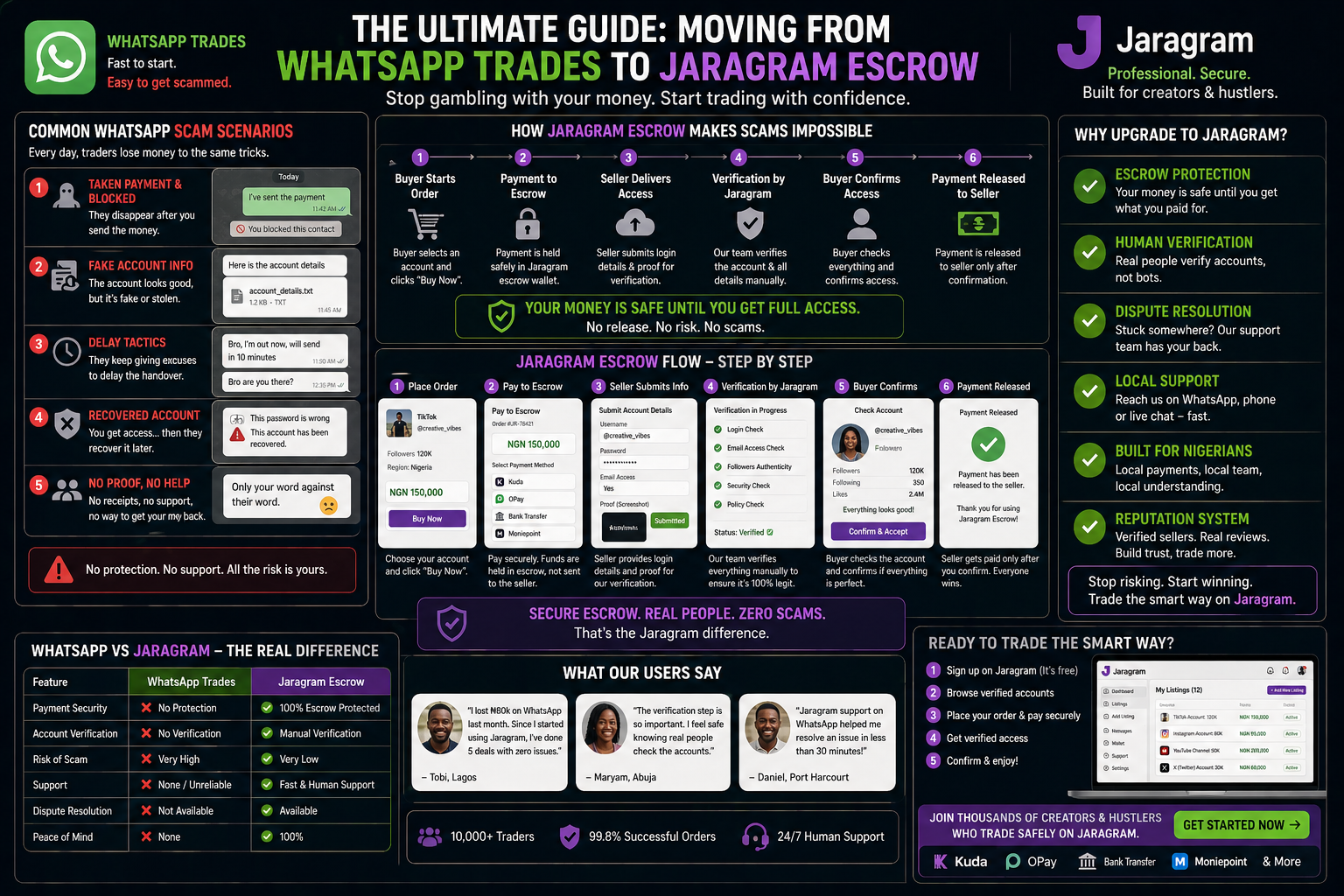
You Have Been Trading on Trust. Here Is What That Trust Has Been Costing You.
WhatsApp is where Nigerian social media account trading was born. Before marketplaces, before escrow, before structured listings, there were WhatsApp groups. Sellers posted available accounts. Buyers expressed interest. Deals were negotiated in direct messages. Payment was sent to a phone number or bank account. Account credentials were delivered. The transaction completed based entirely on mutual trust.
This informal market has handled enormous transaction volume over the years. It thrives because WhatsApp is universal in Nigeria. Everyone already has the app. Everyone knows how to send a message and make a transfer. There is no learning curve, no platform registration, no new interface to navigate. The familiarity is the appeal.
But the WhatsApp trading model has a structural flaw that no amount of trust can fix. Every transaction contains a moment of unilateral vulnerability. Either the buyer sends money first and hopes the seller delivers the account. Or the seller delivers the account first and hopes the buyer sends the money. In that moment, one party has everything and the other party has nothing except hope.
This guide is for the traders who have experienced that moment of vulnerability and the traders who have been lucky so far but know their luck will run out eventually. It explains exactly what makes WhatsApp trades dangerous, walks through the specific scam scenarios that happen every day, and shows how moving to JaraGram escrow makes those scams structurally impossible.
The Trust Moment That Creates Every WhatsApp Scam
Every WhatsApp account trade follows the same fundamental sequence. The buyer and seller negotiate the price. They agree on the account details. Then they reach the critical moment: who moves first?
If the seller has more visible reputation, perhaps they are an admin in the WhatsApp group, perhaps they have been trading longer, perhaps other group members vouch for them, the buyer is expected to send payment first. The buyer transfers the agreed amount. Then they wait. The seller confirms receipt. Then the buyer waits some more. Ideally, the seller immediately delivers the account credentials. But if the seller stops responding, blocks the buyer, or delivers credentials that do not work, the buyer has already sent money that cannot be recovered.
If the buyer has more power in the negotiation, perhaps they are buying multiple accounts and represent ongoing business, the seller might be pressured to deliver the account first. The seller sends the login credentials. The buyer logs in and changes the password. Then the seller waits for payment. If the buyer stops responding or claims there was an issue with the account, the seller has already surrendered an asset that cannot be taken back.
There is no third option in the WhatsApp model. No mechanism that protects both parties simultaneously. The transaction must pass through a moment where one party trusts the other completely. That moment is where every WhatsApp account trading scam begins.
The Five Scam Scenarios Every WhatsApp Trader Knows
These are not theoretical risks. They are recurring patterns that experienced WhatsApp traders recognize because they have either experienced them personally or watched them happen to someone in their trading group.
The Block After Payment
This is the most common and most straightforward WhatsApp scam. The seller posts an attractive account listing in a group. The account has good metrics, reasonable price, and the seller seems legitimate. The buyer negotiates, agrees to the price, and sends payment to the seller's bank account. The seller confirms receipt and says they are preparing the account transfer. Then the seller blocks the buyer on WhatsApp. The buyer has sent money to a bank account that might belong to a money mule rather than the actual scammer. The money is gone. The account never existed.
The Account Reclaim
This scam is more sophisticated because the seller actually delivers the account. The buyer pays, receives the login credentials, changes the password, and feels secure. But the seller retained the Original Email used to create the account. Weeks or months later, after the buyer has invested time growing the account further, the seller uses the Original Email to initiate an account recovery with the platform's support team. The platform sees that the recovery request comes from the Original Email and returns control to the seller. The buyer has lost both the purchase price and the value they added to the account after purchase.
The Fake Middleman
Some WhatsApp groups attempt to solve the trust problem with volunteer middlemen. A respected group member holds the buyer's payment until the seller delivers the account. This sounds safer. But fake middlemen have run long-term confidence operations where they build trust over months, middlemanning small transactions successfully, and then disappear when a large transaction comes through. The buyer sends money to the middleman. The seller delivers the account to the buyer. The middleman vanishes with the money. Both buyer and seller lose.
The Account Switcheroo
The seller shows the buyer detailed screenshots of an impressive account with strong engagement and monetization features. The buyer agrees to the price and sends payment. The seller delivers credentials for a different account, one that looks similar at a glance but has lower followers, no monetization, or fake engagement. By the time the buyer examines the account carefully and realizes the switch, the seller has blocked them. The screenshots were real, but they were of an account the seller never intended to deliver.
The Phantom Buyer
This scam targets sellers. A buyer expresses interest, negotiates aggressively, and agrees to a price. They ask the seller to deliver the account first, perhaps citing a previous bad experience or claiming they need to verify the account before payment. The seller, eager to close the deal, sends the credentials. The buyer immediately changes the password and recovery details, then blocks the seller. The account is gone. Payment was never sent.
How JaraGram Escrow Makes Each Scenario Impossible
Every one of the scam scenarios above relies on the same vulnerability: a moment in the transaction where one party has surrendered their side of the deal and the other party has not. JaraGram escrow eliminates that moment entirely.
Here is how a transaction flows through JaraGram escrow.
The buyer finds a listing they want and initiates the purchase. The platform moves the buyer's payment into escrow. This is the critical first step. The money has left the buyer's account but has not reached the seller. It is held in a protected state that neither party can access unilaterally. The seller can see that funds are secured in escrow, which confirms the buyer is serious and has the money. The buyer can see that the funds are in escrow, which confirms the money is protected and will not be released until they confirm satisfactory delivery.
The seller now transfers the account credentials to the buyer through the platform's structured handover process. The seller has incentive to do this properly because the money is sitting in escrow waiting for them. The buyer has incentive to verify the account promptly because the seller is waiting for the escrow to release.
The buyer receives the credentials, logs in, and verifies that the account matches the listing description. The follower count is correct. The engagement is genuine. The monetization status is confirmed. Most critically, the Original Email has been transferred to the buyer's control. This is the protection against the Account Reclaim scam. The Original Email transfer is verified as part of the transaction process.
Only after the buyer confirms successful receipt and verification does the escrow release the funds to the seller. Not before. The buyer cannot confirm without actually receiving the account. The seller cannot receive payment without delivering the account.
Now consider how this flow makes each WhatsApp scam scenario impossible.
Block After Payment becomes impossible because the buyer does not send money directly to the seller. The funds go to escrow. If the seller blocks the buyer and never delivers the account, the buyer does not confirm receipt. If the buyer does not confirm, the escrow does not release. The seller cannot access the funds without delivering the account. The scam fails because the scammer never touches the money.
Account Reclaim becomes impossible because the structured handover process verifies the Original Email transfer. The seller cannot retain the Original Email and still complete the transaction. The buyer verifies Original Email control before confirming receipt. If the Original Email was not transferred, the buyer does not confirm. If the buyer does not confirm, the escrow does not release. The seller has a direct financial incentive to transfer complete account ownership.
Fake Middleman becomes impossible because there is no middleman. The escrow system is automated and impartial. It does not have a WhatsApp account that can block you. It does not build reputation over months and then disappear. It follows the same rules for every transaction regardless of who the buyer and seller are or how long they have been on the platform. The code enforces the rules, not a person who might be running a long con.
Account Switcheroo becomes impossible because the buyer verifies the account before confirming receipt. If the delivered account does not match the listing description, the buyer raises a dispute instead of confirming. The escrow holds the funds while the dispute is resolved. The seller cannot substitute a different account and expect the escrow to release because the buyer controls the confirmation step.
Phantom Buyer becomes impossible because the buyer's funds are already secured in escrow before the seller delivers the account. A scammer posing as a buyer would need to fund the escrow before receiving any credentials. If they are not willing to put money into escrow, the transaction never progresses to the delivery stage. If they put money into escrow and then attempt to claim they never received the account, the platform's transaction records and structured handover process provide evidence of delivery.
The Visual Escrow Flow: What You See During a Transaction
Understanding the escrow flow intellectually is one thing. Seeing what it looks like from the user's perspective makes the security tangible.
When a buyer initiates a purchase, the transaction screen shows a clear status indicator. The status reads "Payment Secured in Escrow." A timeline displays the steps ahead. Seller delivers account. Buyer verifies and confirms. Funds released to seller. The buyer can see exactly where they are in the process and what happens next.
The seller's dashboard shows the same transaction with the same status. "Buyer's payment secured in escrow. Deliver the account to proceed." The seller can see the money is real and waiting. They know that delivering the account is the only way to access it.
When the seller completes the account delivery, the buyer's transaction screen updates. The status changes to "Account Delivered. Verify and Confirm." The buyer has a clear action to take. They log into the account, check everything, and if satisfied, click confirm. If something is wrong, they click the dispute button instead, and the funds remain in escrow while the support team investigates.
After the buyer confirms, the status updates for both parties. "Transaction Complete. Funds Released to Seller." The seller sees the payout in their JaraGram wallet, ready to withdraw to their bank account. The buyer sees the completed transaction in their history, with all account details recorded for future reference.
At no point in this flow did either party experience the moment of unilateral vulnerability that defines WhatsApp trading. At no point did the buyer send money directly to a stranger. At no point did the seller hand over an account without confirmed funds. The escrow system held the risk for both parties until both had fulfilled their obligations.
What Happens When Something Goes Wrong
The escrow flow described above covers the standard transaction. But what happens when a buyer receives an account and something is not right? This is where the platform's dispute resolution process replaces the WhatsApp group's helplessness.
On WhatsApp, a buyer who receives an account with misrepresented metrics has no structured recourse. They can complain in the group. The seller might respond or might not. The group admin might intervene or might not. The seller might be banned from the group, but the buyer's money is still gone. There is no mechanism to reverse the transaction.
On JaraGram, the buyer who identifies a problem before confirming receipt clicks the dispute button. The transaction status changes to "Dispute Raised. Under Review." The funds remain in escrow, inaccessible to both parties, while the support team investigates.
The support team reviews the original listing description, the delivered account's actual metrics, and any communication between buyer and seller on the platform. If the account clearly does not match the listing, the escrow returns the funds to the buyer and the seller faces platform consequences. If the account does match the listing and the buyer's dispute is not supported by evidence, the escrow releases to the seller.
The key distinction from WhatsApp is that the funds are still there. They did not go to the seller and disappear. They did not stay with the buyer who might refuse to pay. They remained in escrow throughout the transaction, and the platform's impartial review determines their release. The worst-case scenario for an honest party is a delay while the dispute is resolved. The worst-case scenario on WhatsApp is total loss.
Why Traders Still Use WhatsApp
Given the structural risks of WhatsApp trading, why does it remain common? The answer lies in familiarity and speed.
WhatsApp is installed on every Nigerian smartphone. Creating a JaraGram account requires visiting a website or downloading an app, registering, and learning a new interface. The friction is small but real, and for traders who have been operating on WhatsApp for years, the familiar feels safer even when it is not.
WhatsApp transactions can feel faster because they skip the structured process. A deal negotiated in five minutes of rapid messaging and completed with an instant bank transfer feels more efficient than navigating an escrow flow. The speed is seductive, and for small transactions where the trust risk is minimal, it might even be acceptable.
But the speed advantage disappears the moment something goes wrong. A WhatsApp transaction that ends in a scam takes infinitely longer to resolve because it never resolves. The trader spends hours messaging, calling, threatening, and appealing to group admins. The time saved by skipping escrow is lost ten times over in the aftermath of a scam.
The transition from WhatsApp to JaraGram is not about abandoning the speed and familiarity of direct messaging. It is about recognizing that for transactions involving significant money, the structured protection of escrow is not bureaucracy. It is insurance. The few extra minutes spent completing a transaction through escrow protect against the hours and losses of a transaction gone wrong.
Making the Move
The switch from WhatsApp trading to JaraGram escrow does not need to be abrupt. Many successful traders maintain their WhatsApp presence for networking, discovery, and relationship building while routing actual transactions through JaraGram.
The WhatsApp group is where you find buyers and sellers. The JaraGram escrow is where you complete the transaction securely. You negotiate on WhatsApp, agree on terms, and then say: "I will set up the transaction on JaraGram so we are both protected." Legitimate counterparties will agree because they want protection too. Counterparties who refuse escrow and insist on direct payment are sending a signal you should not ignore.
Your first JaraGram transaction will feel slightly unfamiliar, just like your first bank transfer or your first online purchase once did. By your third transaction, the flow will feel natural. By your tenth transaction, you will wonder why you ever traded any other way. The protection that escrow provides is not a constraint on your trading. It is the foundation that lets you trade with confidence, with strangers, and with larger amounts than you would ever risk on a WhatsApp message and a prayer.