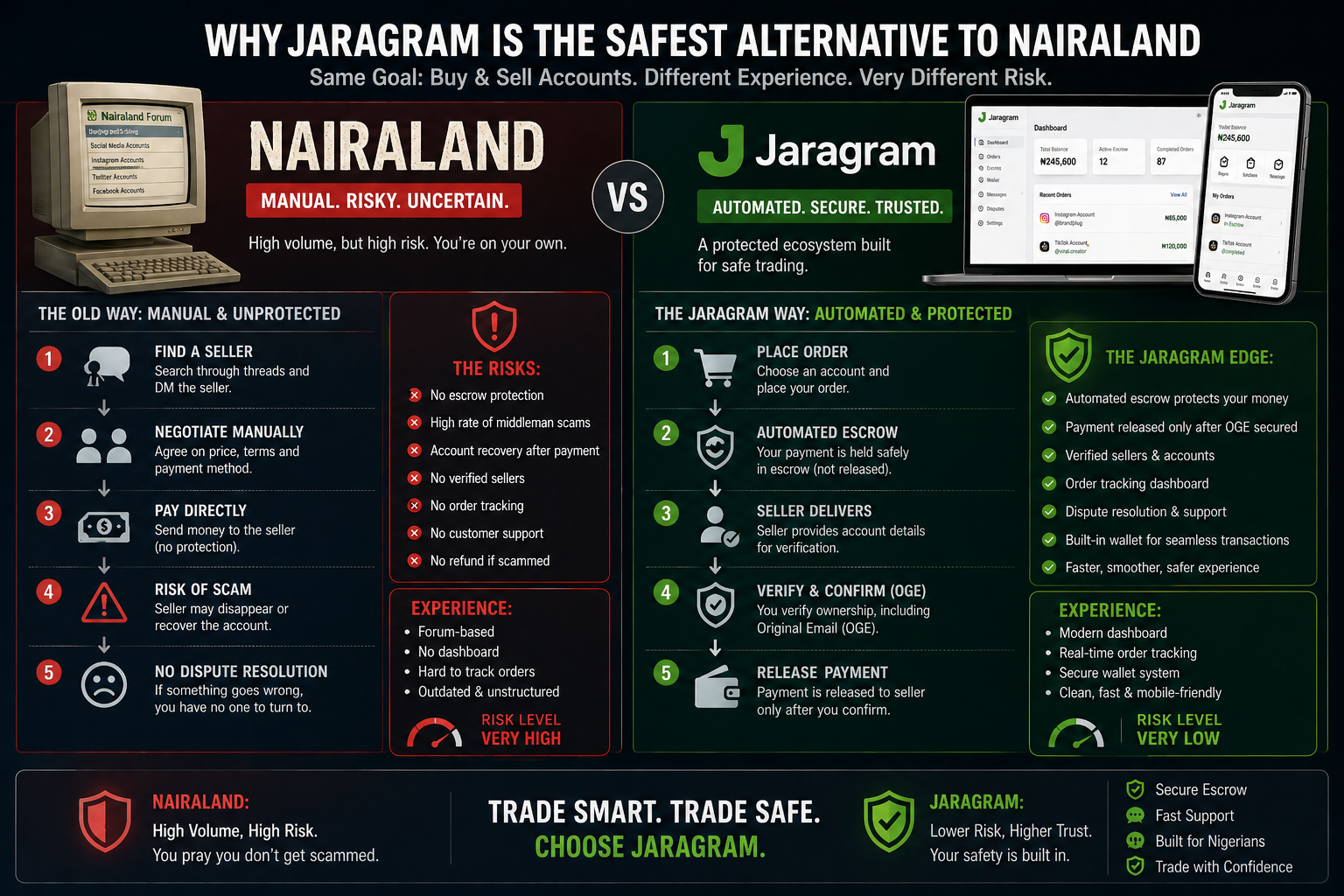
There Is a Reason the Old Way Feels Familiar. It Is Also the Reason People Keep Losing Money.
Nairaland is the undisputed king of Nigerian online forums. For over two decades, it has been the digital town square where Nigerians buy, sell, discuss, and debate everything from real estate to mobile phones to social media accounts. If you want to find a buyer for an Instagram account or locate someone selling a monetized YouTube channel, Nairaland has a thread for that. Probably dozens of them.
The volume on Nairaland is real. Thousands of Nigerians visit the platform daily, and the account trading sections are consistently active. A well-written listing posted at the right time can attract multiple interested buyers within hours. For sellers who understand how to navigate the forum, Nairaland provides access to a massive pool of potential buyers without any platform fees or listing restrictions.
But volume and safety are two completely different things. And on Nairaland, the features that make it a great discussion platform are the same features that make it a risky place to transact. No escrow. No identity verification. No structured transaction records. No dashboard to track deals in progress. Just a forum thread, a handshake emoji, and hope.
This guide compares the manual, trust-based model of Nairaland account trading with the automated, secured model that JaraGram provides. If you have been trading accounts the old way, or if you have been hesitant to enter the market because of the scam stories you have heard, this comparison is for you.
The Manual Model: How Account Trading Works on Nairaland
To understand why the Nairaland model is risky, you need to understand exactly how a typical transaction unfolds.
A seller creates a thread. They describe the account for sale, usually an Instagram or TikTok handle, with follower count, niche, and a price. Interested buyers reply to the thread or send a direct message. The seller and buyer negotiate, agree on a price, and then face the critical question: who moves first?
Does the buyer send money first, trusting that the seller will actually deliver the account after receiving payment? Or does the seller hand over the account credentials first, trusting that the buyer will actually send the money after securing the account? This is the trust gap, and it is where every Nairaland account trading scam originates.
Some participants attempt to solve this with a middleman. A third party, often a Nairaland user with some visible history on the forum, agrees to hold the buyer's funds until the seller delivers the account and the buyer confirms successful transfer. The buyer sends money to the middleman. The seller delivers the account to the buyer. The buyer confirms receipt. The middleman releases funds to the seller.
This sounds reasonable in theory. In practice, it introduces a cascade of risks. The middleman might be a scammer running a long-term con, building a reputation over months before disappearing with a large transaction. The middleman might be genuinely honest but unavailable when a dispute arises. The middleman might lack the technical knowledge to verify that an account transfer was actually completed properly, including the Original Email handover.
And then there are the disputes that a forum middleman is not equipped to handle. The seller delivers the account, but the engagement metrics do not match what was advertised. The buyer claims the account was different from what was described, but the seller insists it was accurate. The middleman, with no formal dispute resolution framework, no structured evidence collection, and no binding authority, is left making a judgment call that one party will inevitably feel was unfair.
This is not to say every Nairaland transaction ends badly. Many traders have completed deals successfully on the forum. But success depends entirely on the honesty of the counterparty and the competence of whoever is playing middleman. There is no system. There is no automation. There is just trust, and trust is a terrible security protocol when significant money is involved.
The Automated Model: How JaraGram Protects Every Transaction
JaraGram was built to eliminate the trust gap entirely. Instead of relying on a forum thread, a handshake agreement, and a volunteer middleman, every transaction flows through an automated escrow system that enforces the rules impartially.
Here is how a JaraGram transaction actually works. The buyer finds a listing they want, reviews the verified account details, and initiates the purchase. The buyer's funds are immediately secured in escrow, not sent to the seller. The funds sit in a protected holding state visible to both parties but accessible to neither until the transaction conditions are met.
The seller receives a notification that funds are secured and proceeds with the account transfer. The seller delivers the account credentials to the buyer through the platform's structured handover process. Crucially, this includes the Original Email, the first email address used to create the account, which is the ultimate proof of ownership on any social media platform.
The buyer receives the credentials, logs into the account, and verifies that everything matches the listing description. The follower count is correct. The engagement is genuine. The Original Email has been transferred. Only after the buyer confirms successful receipt and verification does the escrow release the funds to the seller.
If something is wrong, the buyer raises a dispute before confirming receipt. The funds remain in escrow. The platform's dispute resolution team steps in with a structured process that examines the listing description, the evidence from both parties, and the platform's transaction records. A decision is reached based on documented policies, not a middleman's gut feeling.
This is the fundamental difference between manual and automated security. On Nairaland, your money is protected by the reputation of a person you have probably never met. On JaraGram, your money is protected by a system that cannot be sweet-talked, cannot get busy with other things, and cannot disappear.
The Original Email Lock: Why OGE Matters More Than Password
A password can be changed in seconds. A phone number linked to two-factor authentication can be swapped. But the Original Email used to create a social media account is the permanent root of account ownership. Platform support teams use the Original Email as the ultimate identifier when determining who owns an account. A seller who retains access to the Original Email can reclaim the account from a buyer at any time, potentially weeks or months after the transaction.
This is why the OGE handover is the most critical part of any account transaction, and it is where the Nairaland manual model fails most catastrophically.
On Nairaland, a buyer might receive the account password, change it, add their own phone number, and feel secure. They have no way to independently verify whether the seller still holds the Original Email. The seller might have handed over a recovery email that was not actually the original one. The buyer might not discover this until months later when the account is suddenly reclaimed, and by then the seller, the middleman, and the forum thread are all long gone.
JaraGram's escrow system ties the funds release directly to the OGE verification. The platform's structured handover process requires the seller to transfer the Original Email as part of the transaction fulfillment. The buyer can verify the OGE before confirming receipt. If the Original Email is not transferred, the buyer does not confirm. If the buyer does not confirm, the escrow does not release. The seller has a direct financial incentive to complete the OGE handover properly because their money is sitting in escrow waiting for it.
This single mechanism, automated escrow conditional on OGE verification, prevents the most common and most damaging scam in the account trading market. It is a protection that no forum thread, no volunteer middleman, and no amount of Nairaland reputation points can replicate.
The Dashboard Difference: Tracking Deals Instead of Scrolling Threads
Beyond the security architecture, there is a practical usability difference between trading on a forum and trading on a purpose-built platform. It comes down to the dashboard.
On Nairaland, your transaction history is scattered across forum threads, private messages, and chat apps. To check the status of a deal in progress, you scroll through messages. To review a past transaction, you search your message history. To provide evidence in a dispute, you screenshot conversations and hope the other party does not claim the screenshots are doctored.
JaraGram replaces this chaos with a structured dashboard. Every transaction you initiate appears as a card with a clear status indicator. Pending payment. Payment secured in escrow. Account transfer in progress. Buyer verification pending. Funds released. Each status is updated in real time as both parties complete their steps.
Your transaction history is a searchable, filterable record of every deal you have completed on the platform. You can see what you bought, what you sold, when you transacted, and the final value. This is useful for tracking profitability, but it is also a security asset. If a dispute ever arises about a past transaction, the platform holds the verifiable record. No one can claim a payment was not made when the platform recorded it. No one can claim an account was not delivered when the platform timestamped the OGE transfer.
This structured approach extends to communication. Buyer-seller messaging happens on the platform, not across WhatsApp and Telegram where messages can be deleted and records lost. If a seller makes a specific claim about engagement metrics in the platform chat, that claim is part of the transaction record. If a dispute arises and the claim turns out to be false, the evidence is built into the platform, not dependent on whether the buyer screenshotted the conversation.
Why the Old-School Crowd Is Making the Switch
The Nairaland trading community is built on relationships and familiarity. Many traders have used the forum for years, recognize the usernames of frequent participants, and feel comfortable in the environment they know. Switching to a new platform means leaving that familiarity behind.
But the switch is happening anyway, and it is accelerating. The reason is simple. Every time a Nairaland trader gets scammed, or watches someone in their network get scammed, the limitations of the manual model become impossible to ignore. The cost of one bad transaction wipes out the profit from several good ones. The time spent resolving disputes, chasing middlemen, and trying to recover lost accounts adds up.
JaraGram does not require traders to abandon their Nairaland networks. Many successful sellers use both. They maintain a presence on Nairaland to connect with buyers and build visibility, then direct serious buyers to complete the transaction on JaraGram where the escrow protects both parties. The forum becomes a discovery channel, and the platform becomes the transaction layer.
This hybrid approach gives traders the best of both worlds. The massive audience and community connections of Nairaland, combined with the structured security and automated escrow of JaraGram. It is not an either-or choice. It is a better way to structure the transaction once you have found your counterparty.
What the Automated Model Means for the Market
The shift from manual forum trading to automated platform escrow does more than protect individual buyers and sellers. It grows the entire market.
When buyers trust that their money is protected until they receive exactly what they paid for, they are willing to transact at higher values. A buyer who would never risk ₦500,000 on a Nairaland forum thread might comfortably spend that amount on a JaraGram transaction knowing the escrow protects them. This expands the pool of capital available in the account trading market.
When sellers know that the platform will verify their delivery and release their funds without requiring them to chase a buyer for payment, they list more accounts. The time and stress saved on each transaction translates into more deals completed. Sellers who got burned by a bad buyer on Nairaland and quit the market entirely find that the automated model makes selling viable again.
The market grows, transaction values increase, and both legitimate buyers and legitimate sellers benefit. The only parties who lose are the scammers who relied on the trust gaps in the manual model to defraud people. And that is exactly the point of building a protected ecosystem instead of a forum thread.