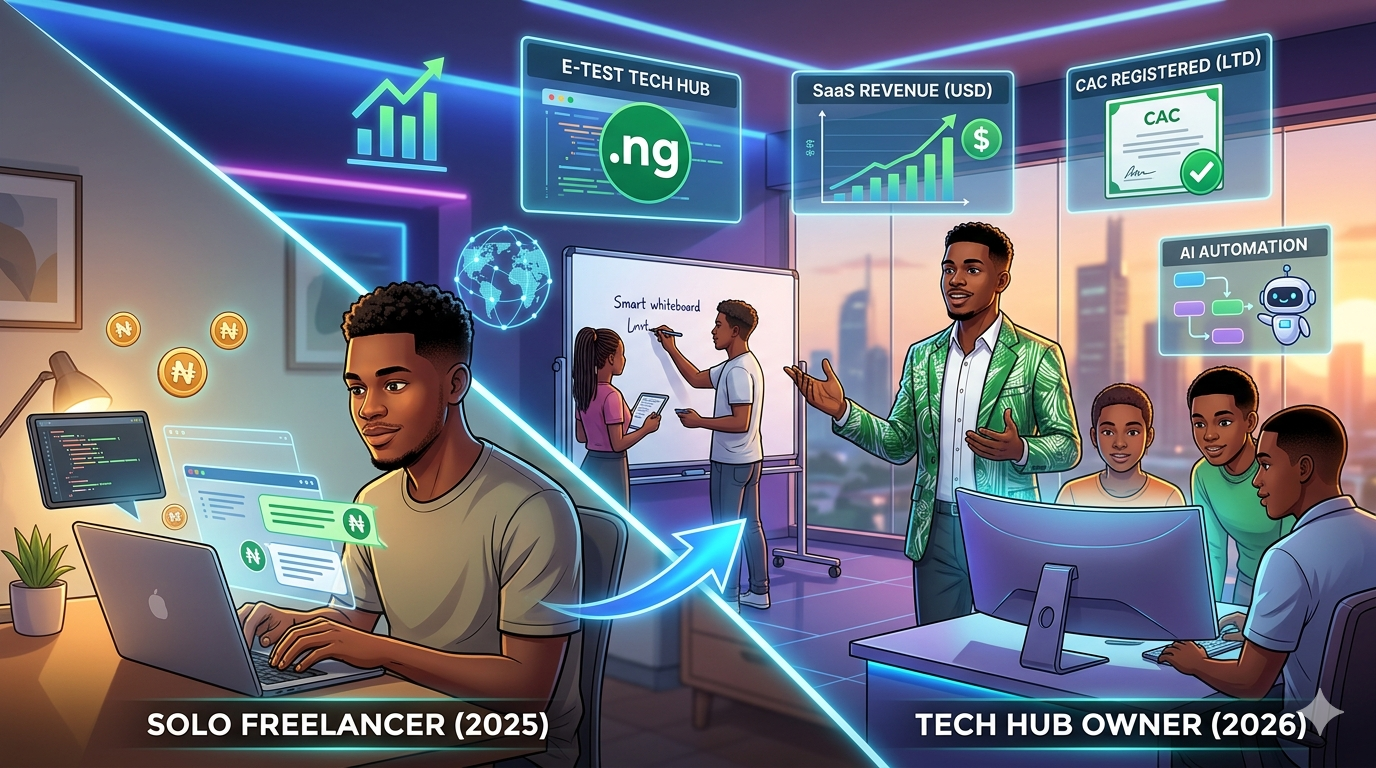
If you are still thinking like a solo freelancer in 2026, you are sleeping on a bicycle! We all know how things are these days. Being a "one-man army" is great when you are starting, but if you want to build real wealth and move away from chasing every ₦50,000 gig, you must transition into a Business Entity.
Moving from a freelance dev to a Tech Hub owner (like E-Test Tech Hub) is the ultimate level-up. It’s the difference between "working for money" and "owning a system that makes money." I want to show you the exact 2026 Nigerian Business Roadmap to flip your coding skills into a scalable digital empire.
The Logic: Why the "Hub" Model?
In 2026, the Nigerian tech ecosystem has shifted from "growth at all costs" to sustainable value. A Tech Hub allows you to:
The Process: Your 4-Step Scaling Blueprint
Step 1: Legalize the Hustle (CAC i-CRP)
You cannot run a Tech Hub from a personal bank account. In 2026, the Corporate Affairs Commission (CAC) has launched the i-CRP (AI-Powered Registration Portal) for instant approvals.
Step 2: Build Your "Digital Office"
A Tech Hub without a powerful online presence is just a fancy name. Since you are already a developer, this is your home ground.
Step 3: Implement the "AI Operator" Layer
One of the biggest mistakes freelancers make when scaling is hiring too many people too fast. In 2026, sharp Hub owners use AI Agents to keep overhead low.
Step 4: Productize Your Skills (The SaaS Pivot)
Don't just sell services; sell products. A true Tech Hub owns intellectual property.
Important Rules (The "No-Go" Areas)
1. Compliance is a Competitive Advantage: With the 2026 data protection laws in Nigeria, ensure your Hub has a clear Privacy Policy. Being compliant makes you more attractive to international partners.
2. Avoid "Ghosting" Clients: As you scale, communication often drops. Use project management tools (like Trello or Notion) to ensure your team delivers on time. Your reputation is your most valuable asset.
3. Separate Personal and Business Funds: This is the #1 reason Nigerian startups fail. Use a dedicated Jaragram Business Wallet to manage your Hub’s revenue separately from your personal "chop money."
Final Word
Transitioning from a freelancer to a Tech Hub owner is a mindset shift. It requires moving from "I do it all" to "I oversee it all." The 2026 digital economy favors those who build systems, not just those who write code.
Ready to start your journey? If you need to fund your registration or buy tools from our marketplace, use the JaraGram Exchange to get the best value for your digital assets today.
Frequently Asked Questions
How much does it cost to register a Tech LTD in 2026?
Official CAC fees for a Private Limited Company usually range from ₦15,000 to ₦50,000, depending on your share capital and if you use an accredited agent.
Do I need a physical office to be a "Hub"?
In 2026, No. You can start as a Virtual Tech Hub. As long as your digital presence is professional and your team is coordinated via Slack or Discord, your location doesn't matter.
How do I find developers to join my Hub?
Start with your existing network. Look for junior devs who are hungry to learn. You provide the brand and the clients; they provide the labor. It’s a win-win.