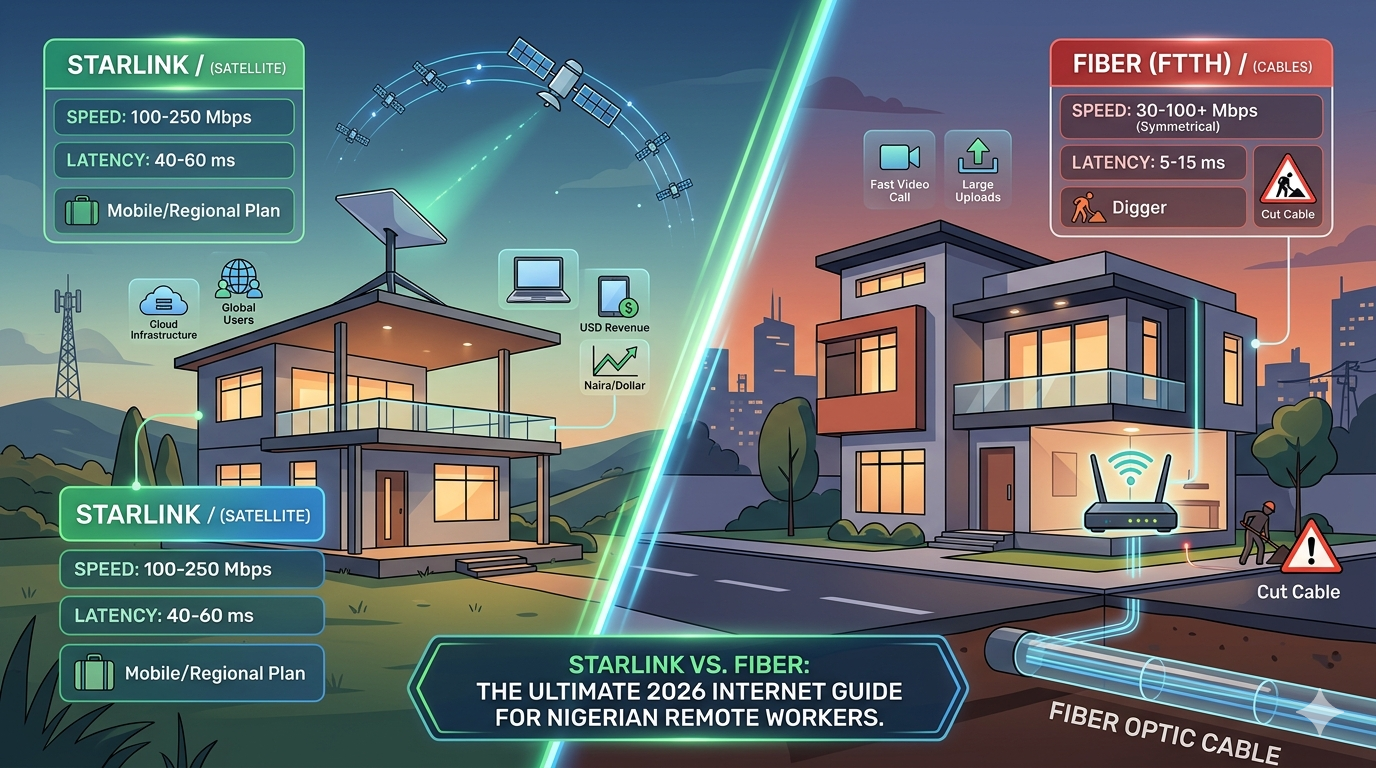
If you are working a high-paying remote job or running a digital business in Nigeria, you know that "Network is down" is a sentence that can cost you thousands of Dollars. In 2026, the battle for internet supremacy is between the "Sky" (Starlink) and the "Ground" (Fiber-to-the-Home).
But which one should you actually put your money on? With the Naira currently at ₦1,385 and inflation hitting hardware costs, making the wrong choice is an expensive mistake. I want to show you the simple "Speed, Cost, and Uptime" breakdown so you can stay connected and keep earning.
The Contenders: Starlink vs. Fiber
For years, we relied on shaky 4G routers. Now, we have two heavyweight options:
The Performance Breakdown
1. Speed and Latency (The Ping Factor)
If your work involves heavy Zoom calls, Google Meet, or uploading large files to a SaaS platform, latency (ping) is more important than raw download speed.
2. Reliability and Weather
Nigeria’s rainy season is the ultimate test for any internet provider.
3. Setup and Monthly Costs
Let’s talk about the money. Staying online in 2026 is an investment.
Which One Should You Choose?
Choose Fiber If:
Choose Starlink If:
Important Rules (The Backup Strategy)
1. The Hybrid Rule: For a serious remote worker, having only one internet source is a risk. Many "big boys" in the tech space now use Fiber as their primary connection and keep a Starlink or a high-quality 5G router as a backup.
2. Power Matters: Your internet is useless during a blackout. Ensure your Starlink or Fiber router is connected to a decent UPS or an Inverter system.
3. Account Security: Whether you are using Starlink or Fiber, ensure your router password is strong. If you are managing multiple client accounts or crypto wallets, consider using a dedicated hardware security key for your logins.
Final Word
In 2026, the "best" internet is the one that stays on when you need it most. If you are in a major city, Fiber offers the best value for your Naira. If you are in a remote area or want total independence, Starlink is the way to go.
Whichever you choose, make sure your digital assets are protected. If you need to flip your tech earnings into crypto or Naira instantly, check out the JaraGram Exchange for the fastest rates.
Frequently Asked Questions
Can I use Starlink while traveling in Nigeria?
Yes, if you have the "Mobile/Regional" plan. You can take your dish to your village or a beach house and stay connected, though the monthly sub is higher than the Residential plan.
Is Fiber really unlimited?
Most Nigerian ISPs have a "Fair Usage Policy" (FUP). For example, after you use 1TB or 2TB of data, your speed might drop. Always read the fine print on your provider's website.
Does Starlink work during a blackout?
The satellites are always up, but your Dishy needs power. You will need a power station or an inverter that can pull about 50W-75W to keep it running.