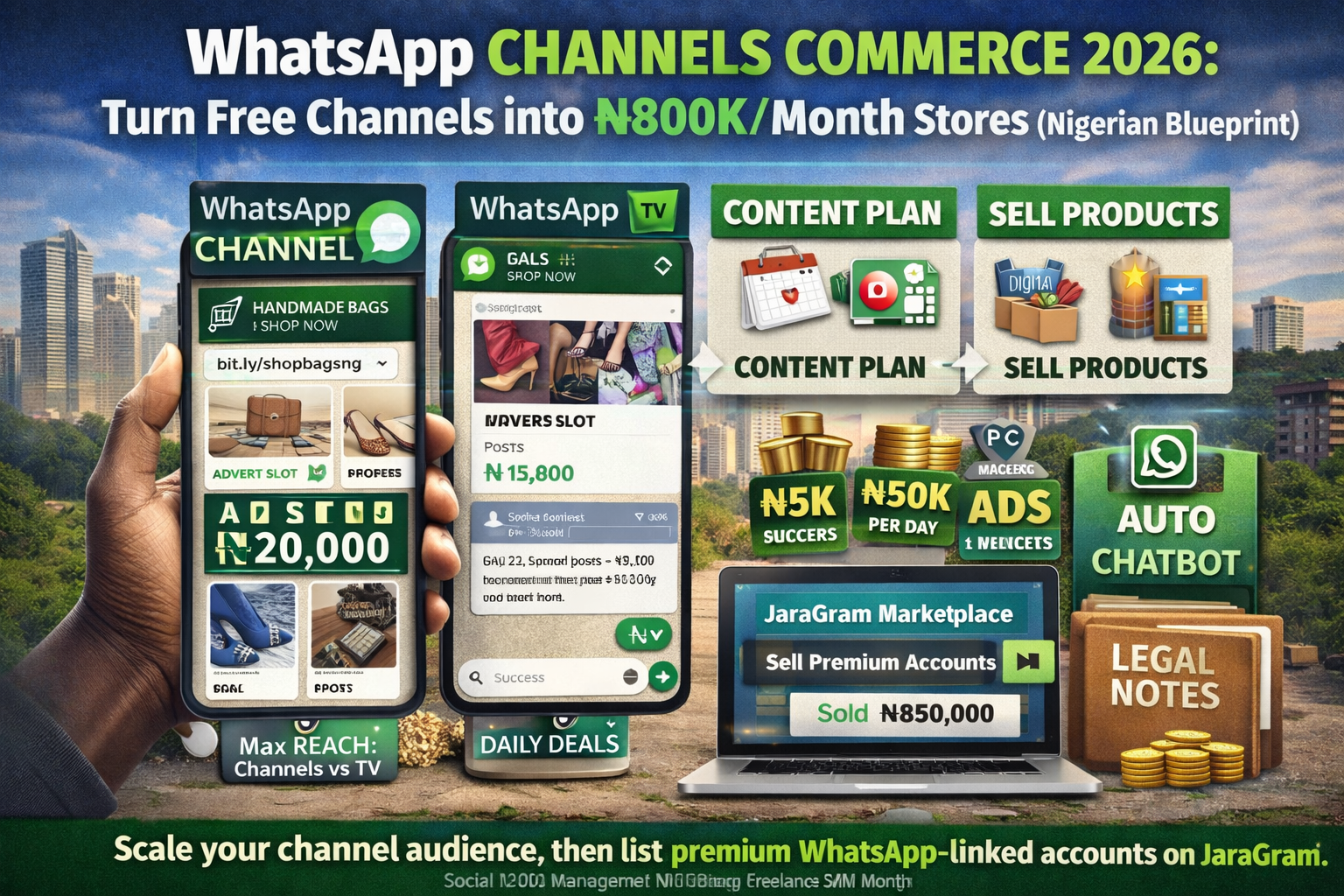
WhatsApp Channels Commerce 2026: Turn Free Channels into ₦800K/Month Stores (Nigerian Blueprint)
Most Nigerian sellers are still using WhatsApp as a chat app. Meanwhile, the smart ones are quietly pulling ₦800K–₦1M+ monthly using WhatsApp Channels — Meta’s one-way broadcast tool that lives in the Updates tab. Here’s the kicker: 95% of Nigerian internet users are on WhatsApp[reference:0], messages boast 98% open rates[reference:1], and 67% of online purchases in Nigeria begin with a chat[reference:2]. This guide walks you through exactly how to claim your share.
Step 1: Channel vs. Status vs. API — Which One Gets You Paid?
In 2026, WhatsApp offers three distinct selling surfaces. Each has a role in your ₦800K/month machine:
| Surface | Best For | Monetization Method |
|---|---|---|
| WhatsApp Channel | One-way broadcasts to unlimited followers | Paid subscriptions (₦600–₦3,500/month), affiliate links, sponsored slots |
| WhatsApp Status | Daily visual updates (disappears in 24h) | Status Ads (native tappable ads), product showcases |
| WhatsApp Business App | Two-way conversations, catalog, quick replies | Direct sales via payment links, broadcast lists (256 contacts max) |
| WhatsApp Business API | Automation, chatbots, unlimited broadcasts (paid) | Enterprise selling, CRM integration, abandoned cart recovery |
The 2026 hack: Use a free Channel for mass reach and authority. Use Status for daily visibility. Use the Business App for closing sales. Upgrade to API only when you hit 100+ daily customer conversations.
Channel Subscriptions — Meta’s native paid tool rolling out in Nigeria — lets you charge followers monthly for exclusive content. Meta takes a 10% platform cut[reference:3]. Starter pricing for Nigerian creators: ₦600–₦1,500/month for niche info; ₦2,000–₦3,500 for premium resources[reference:4].
Step 2: The 2026 Content Calendar — Broadcasts + Status + Channel
Consistency is the algorithm they don't talk about. WhatsApp has no algorithm deciding who sees your content — it's chronological and unfiltered[reference:5]. But your audience will mute you if you spam.
Weekly Content Mix for ₦800K/Month:
| Day | Channel Post (Long-Form) | Status Update (Visual) |
|---|---|---|
| Monday | Industry tip + link to blog | Product spotlight (photo) |
| Tuesday | Flash sale announcement | Behind-the-scenes (video) |
| Wednesday | Customer testimonial | Poll (“Which color do you prefer?”) |
| Thursday | Affiliate product review | Quick tip (text overlay) |
| Friday | Weekend deal + CTA | User-generated content repost |
| Saturday | Free resource download | Limited-time code |
| Sunday | Preview of next week’s paid content | Voice note thank you |
Pro tip: Voice notes have 25% higher engagement than text[reference:6]. Post 3–5 times per week maximum to avoid mute fatigue[reference:7]. Always end with a CTA: “Reply with YES to order” or “Tap the link below.”
Step 3: Selling Physical & Digital Products — The Link + Payment Workflow
The Nigerian social commerce market is projected to exceed $10 billion by 2027[reference:8]. Here’s how to capture it without a website.
Physical Products (Fashion, Food, Accessories, Electronics):
Digital Products (E-books, Courses, Templates, Coaching):
Fulfillment workflow for 2026:
Sellers using this structured approach build trust signals — payment links, automated confirmations, dispatch notifications — that reduce buyer risk perception and drive repeat purchases[reference:10].
Step 4: Ad Space Pricing — ₦5K to ₦50K Per Slot
Your WhatsApp Channel is an ad inventory. Brands will pay to reach your engaged audience. Here’s your 2026 rate card:
| Channel Size (Followers) | Sponsored Post (Single) | Sponsored Post (Weekly) | Monthly Banner Slot |
|---|---|---|---|
| 1,000 – 5,000 | ₦5,000 – ₦10,000 | ₦20,000 – ₦35,000 | ₦40,000 – ₦60,000 |
| 5,000 – 20,000 | ₦10,000 – ₦20,000 | ₦35,000 – ₦60,000 | ₦60,000 – ₦120,000 |
| 20,000+ | ₦20,000 – ₦50,000 | ₦60,000 – ₦150,000 | ₦120,000 – ₦300,000 |
How to sell ad slots:
Step 5: Automation with Chatbots — Handle 100+ Customers Daily
The WhatsApp Business App limits you to one device and no automation. The WhatsApp Business API unlocks multi-agent support, chatbots, and unlimited broadcasts[reference:12]. But API costs per conversation (marketing conversations ~$0.042 each)[reference:13].
For Nigerian sellers starting out, use these free/low-cost automation tools:
| Tool | Cost | What It Does |
|---|---|---|
| CDIAL.AI | Free tier | AI chatbot in Yoruba, Pidgin, Hausa, English — built for Nigeria[reference:14] |
| ManyChat | Free up to 1,000 contacts | WhatsApp automation, keyword triggers, broadcast |
| ChatDaddy | Paid | WhatsApp Business API with Nigerian support, CRM integration[reference:15] |
| Zoho CRM | Free tier | Track leads from WhatsApp, send follow-up reminders[reference:16] |
What to automate immediately:
Businesses using AI chatbots reduce response time from hours to minutes and close more deals because they never miss a hot lead[reference:17].
Step 6: Real Nigerian Success Metrics (2026 Data)
Let’s talk numbers. These are not theories — they are happening right now.
| Metric | 2026 Figure |
|---|---|
| WhatsApp users in Nigeria | 55+ million[reference:18] |
| Internet users on WhatsApp | 95%[reference:19] |
| Message open rate | 95–98%[reference:20] |
| Click-through rate (well-targeted) | 45–60%[reference:21] |
| Response rate vs. email (45% vs 6%) | 8x higher[reference:22] |
| Conversion rate vs. email | 3–5x higher[reference:23] |
| Nigerian purchases starting with a chat | 67% (global avg 22%)[reference:24] |
| Projected social commerce market (2027) | $10 billion+[reference:25] |
Real case study: A skincare brand owner in Lagos grew her WhatsApp broadcast list to 8,000 contacts while her Instagram had only 2,000 followers. Every product drop sells out in 48 hours — no paid ads, no influencer marketing[reference:26]. That’s the power of direct access.
Another example: Lokoja frozen foods seller Mrs. Zainab Musa now gets more than half her sales from WhatsApp — customers order via chat, pay by bank transfer, and receive delivery via rider[reference:27].
Step 7: Legal Notes — Staying Safe Under 2026 Nigerian Regulations
Nigeria’s regulatory environment tightened significantly in 2026. Ignorance is not a defence.
Key compliance rules for WhatsApp sellers:
Your 2026 Compliance Checklist:
The 30-Day Launch Calendar for ₦800K/Month
| Days | Action |
|---|---|
| 1–5 | Set up WhatsApp Business App. Create Catalog with 10–20 products. Set up quick replies. |
| 6–10 | Create your WhatsApp Channel (Updates → “+” → New Channel). Brand name, logo, bio. Post 1 valuable tip daily. |
| 11–15 | Promote Channel: Share link on Instagram bio, Facebook page, email signature. Add “Join my WhatsApp Channel” sticker to product packaging. |
| 16–20 | Post first sponsored ad slot offer. DM 10 local brands with your Media Kit. Close first ₦5K–₦10K deal. |
| 21–25 | Set up chatbot (CDIAL.AI or ManyChat) for automated FAQs and order confirmations. Test with 10 customers. |
| 26–30 | Launch paid Channel subscription (₦1,000/month for exclusive tips). Convert 50 free followers → ₦50K MRR. |
By Day 30: You have 2,000+ Channel followers, ₦50K–₦100K from ads + subscriptions, and a repeatable system. Month 2: Scale to 10,000 followers, add affiliate products, hit ₦400K. Month 3: ₦800K+.
Final Step: Scale Your Channel Audience, Then List Premium WhatsApp-Linked Accounts on Jaragram
Here’s the 2026 exit strategy most creators miss. After 3–6 months of consistent growth, your WhatsApp Channel becomes a valuable digital asset:
Instead of starting from scratch with a new niche, you can sell the entire WhatsApp-linked account on the Jaragram Marketplace. Other sellers, brands, and agencies will pay for a pre-built, revenue-generating channel.
What you can list on Jaragram:
Example: You build a fashion-focused WhatsApp Channel generating ₦400K/month from subscriptions and ad slots. After 6 months, you list it on Jaragram Marketplace. A buyer pays you 4–6 months of net profit (₦1.6M–₦2.4M) to take over. You cash out and reinvest in a higher-margin niche — or build a second channel in half the time.
That’s how you turn WhatsApp Channels from a free tool into a scalable, sellable business.
Start your Channel today. Build the asset. Then flip it on Jaragram Marketplace for instant capital.
Scale your channel audience, then list premium WhatsApp-linked accounts on Jaragram.